
The tiny town that Hobos from across the midwest flock to every summer.
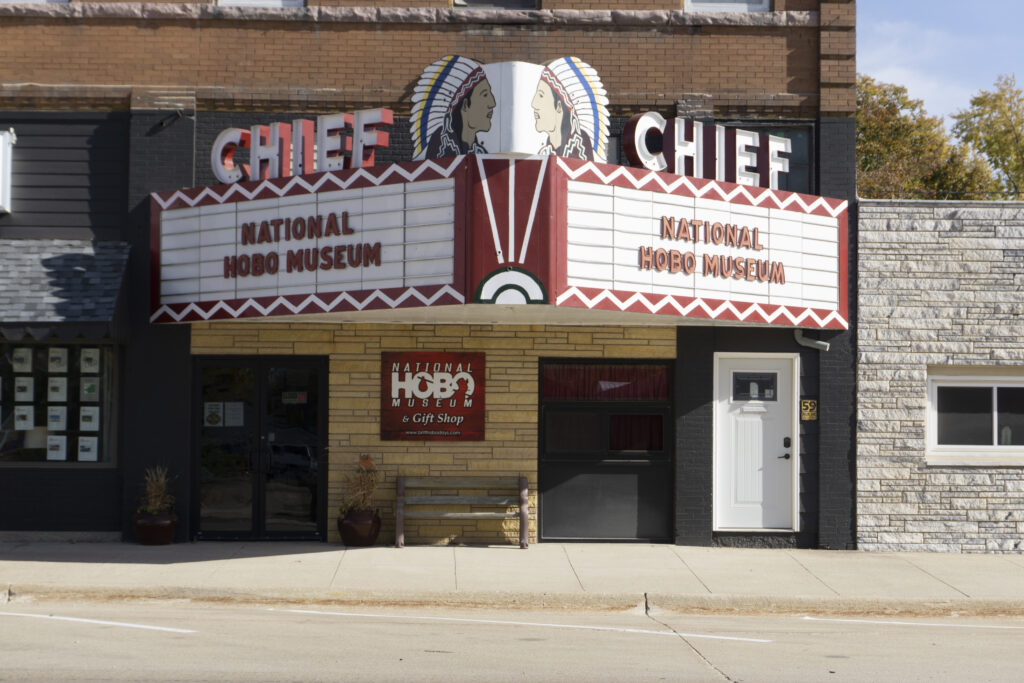
The 2,000-person town of Britt, Iowa, is far from a conventional bucket list destination at face value. The town sits two hours north of Des Moines, three hours south of Minneapolis, and 30 minutes from the nearest interstate, making it about as out of the way as possible. Even so, Britt has managed to quietly carve itself a piece of national notoriety within American history.
Despite its unassuming size, Britt is a home base for one of the Midwest’s most unique and historic communities. That community is that of the Hobos — migratory workers who are “homeless” by choice, traveling from one odd job to another via freight trains — that originated after the Civil War, a time in which many men were out of work.
The Midwest became a hotspot for Hobos due to the high availability of temporary work like railroad construction and seasonal farm jobs. Due to this vastness, residents of Britt began to ponder if the town’s central location was worthy of the kind of Hobo conventions held in large Midwestern cities like Chicago.
“Back in 1900, the editor of the newspaper here in Britt and a couple of his friends saw that the Hobo Tourist Union No. 63 had a convention in Chicago,” Bill Friedlow, president of the National Hobo Museum in Britt, said. “Then they thought, ‘Why shouldn’t they have it in Britt, Iowa?’”
As the newspaper editor and other community members in Britt attempted to set up the first convention, they found that Hobos in the Midwest were skeptical of an unconventional small-town gathering. Fear of law enforcement is often unavoidable among those living out the Hobo lifestyle. In illegally hopping from freight train to freight train to travel, Hobos had risked jail time for decades. “At first, the Hobos were against it because they thought it was a trap,” Friedlow said. “They thought, ‘Yeah, you’ll get all the Hobos into one town and they’ll all get arrested.’”
Thankfully for Britt, coercing the Hobos in question wasn’t an impossible task.
“Rumor has it that when they offered them free beer, they decided to have it,” Friedlow said. “So in 1900, the first Hobo convention was held.”
The Hobo Days Convention
Since 1900, the Hobo Days Convention has been an annual occurrence, and is held during the second weekend of August. Hobos from all across the Midwest come to Britt to set up the “Hobo Jungle”— a grassy field filled with tents surrounding a central fire circle— sell crafted goods, and participate in numerous festivities.
“Thursday night is the official start, down in the Hobo Jungle,” Friedlow said. “They light a bonfire that stays burning until Sunday afternoon when the convention is over.”
During the lighting ceremony, Hobos salute the four winds: north, west, east, and south. At times, there’ll be a dubbing ceremony where people taking on the Hobo lifestyle can become an “official Hobo,” being dubbed such by the Hobo king and queen of the previous year.
“They put their sticks on your shoulder and alternate them and then say to the audience, ‘Is he worthy?’” Friedlow said. “Then the audience will say if he is worthy, and if it’s a yes, [they] will receive a certificate with an official Hobo name.”
Becoming a Hobo king or queen is a highly regarded honor among those who attend Hobo Days. To become one, participants must give a speech to a crowd of tourists and official Hobos entailing their journey.
“I remember I was up there alone, and they’re just sitting listening and judging you,” Minneapolis Jewel, a four-time Hobo queen, said. “I went to the Hopknot Bar and had a couple of shots of Southern Comfort to build up courage.”
After each Hobo completes their speech, the crowd votes via applause on who they think should be crowned Hobo king and queen for the year.
“When the time came to get up there, I totally forgot what I had practiced and just mumbled something,” Jewel said. “But apparently it was sincere enough and the crowd clapped for me, and I was crowned queen that year with Rambling Rudy [as king].”
On the Friday of each convention, the Hobos hold a funeral service for any Hobos who have “caught the westbound,” a term used when a Hobo passes away. On the western end of town, a small section of the town’s graveyard is specially sectioned off for Hobo kings and queens who have caught the westbound. Just beside it are the gravestones of other Hobos who have also passed.
“Saturday – that’s the big day,” Friedlow said. “There’s a concert with a high-quality band. Then there’s the parade which is about an hour and a half long, and I would guess about 10,000 people come to see it. It’s really something.”
On Saturday, the convention reaches its peak, ending with the coronation of the Hobo king and queen to end the night.
The convention has stood as Britt’s largest summer event, and the town proudly holds it close to its heart.
“Whenever I go to meetings or anyplace outside of Britt and say where I’m from, they say, ‘Oh, that’s where the Hobos are,’” Friedlow said. “So I think it’s extremely important to the town.”
The National Hobo Museum
Beyond the Hobo Days convention, Britt stands as the core of Midwestern Hobo history through the National Hobo Museum in the center of town.
The museum opened in 2017 after the building — a former theater — had laid dormant under the ownership of the Hobo Foundation since they purchased it in 1989 with the eventual goal of turning it into a museum. This organization was started in the mid-1970s by former Hobos.
“Not much care was given to [the building],” Friedlow said. “I think the president lived in New Jersey and the treasurer lived in Minneapolis. There was no [person who was] local, so it just went downhill. In 2017, the Hobo Foundation gave it to us. They gave us money to take it.”
After the Hobo Foundation gave the theater to the Hobo Days Committee in Britt, Friedlow and other community members fixed it up and opened it to the public.
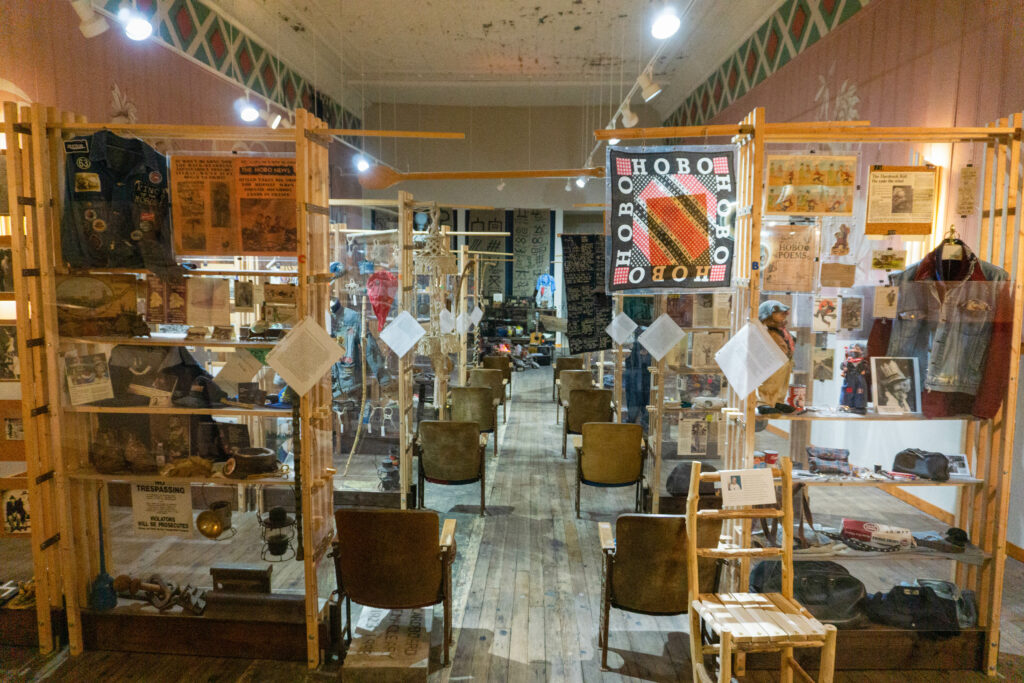
The museum itself is a unique place. Upon entering, visitors are greeted with a barrage of exhibits that feature old belongings, books, and letters from past Hobo kings, queens, and other travelers.
Inside, several exhibits hold stories and letters by famous Hobos like the Pennsylvania Kid, Frisco Jack, and Steam Train Maury. These stories recount the journeys, hardships and relationships that Hobos have experienced throughout their lives.
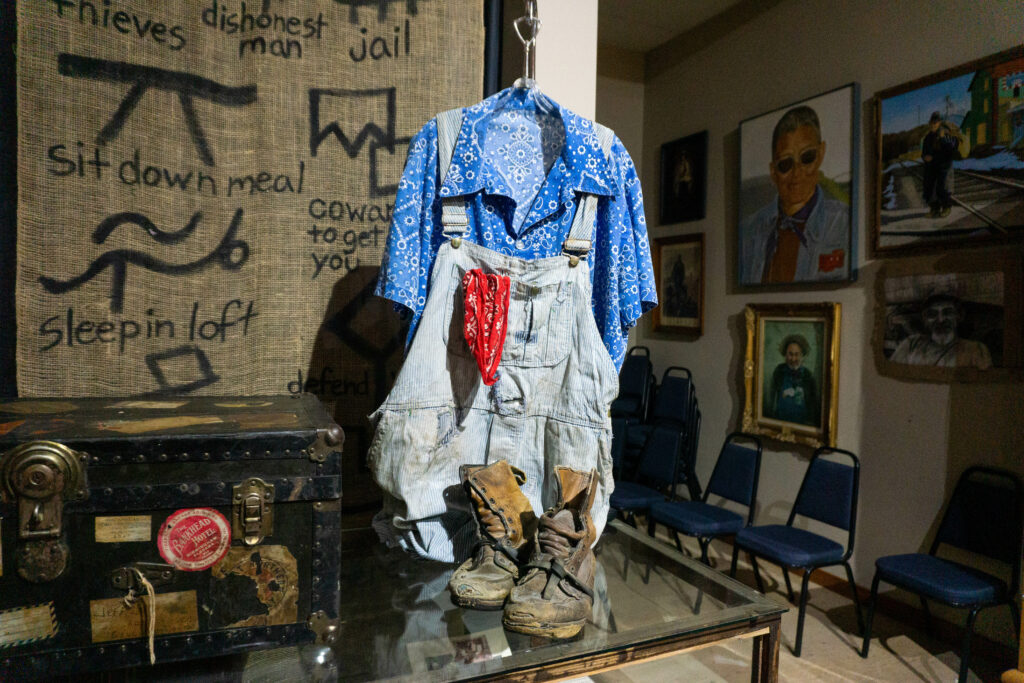
Every old pair of jeans, can of soup, or handwritten note, reveals a deeper story – tales of discovery, hardship, and camaraderie.
For those who know nothing about the Hobo lifestyle, the museum is a perfect place to begin learning. It tells the stories within with such passion and care that they can become entrancing.
One exhibit, highlighting Gas Can Paddy, tells the story of the Hobo who began carrying a gas can filled with his belongings alongside him to disguise as an unfortunate driver and catch rides more easily.
“My days as a Hobo were a great experience,” Gas Can Paddy said, per the exhibit. “People would say to me, ‘Paddy, didn’t you kind of waste your life away?’ I don’t think I did. I learned a lot, and it was a great adventure.”
These exhibits stretch the length of the museum, stacking atop each other like large wardrobes. Each one holds several pieces of Hobo memorabilia, handcrafted works, and belongings.
“The fact that the museum’s there, for somebody just coming in off the street, it’s kind of a mind blower that such a thing even exists,” Jewel said. “The town does a great job of honoring the Hobo.”
In educating those who visit, each exhibit stands as a part of a larger collective effort to preserve the stories of the Hobos.
“When you read their books, that’s the message they quite often try to get through, ‘Keeping the Hobo culture alive,’” Friedlow said.
Continuing down the center of the museum — divided by aging theater seats — there is a display of what a common Hobo encampment looks like. To the left of that, a large railroad crossing sign flashes red, symbolizing the importance of railroads to the Hobo community and the subsequent importance of Hobos to them.
The museum encapsulates why Hobos loves living their lifestyle so much. Their draw towards exploration, self-sufficiency, and human connection is unbridled, and the written stories within the museum showcase that.
“I think [Hobos are] a very important part of American history,” Jewel said. “They helped build the railroads. They helped harvest the food. I think the Hobos are kind of forgotten.”
As it stands, the National Hobo Museum aims to remind the public not only of the importance of Hobos to the country but also of the fascinating lives they’ve led.
“Our mission here is to celebrate the life and times of the American Hobo and the century-old tradition of the National Hobo Convention,” Friedlow said.
The museum is open throughout the summer and via appointment during the off-season, allowing visitors to explore the establishment year-round.
The Future of the Hobo Core
As the Hobo community marches forward with each passing of the annual Hobo Days celebration, younger people still participate despite the dwindling lifestyle.
“It’s the young ones that are keeping the tradition of living outside and riding the trains alive,” Jewel said. “I give them credit for that, even though it’s changed from how I grew up.”
For the town of Britt, continuing traditions is important to their community members and local businesses.
“It’s very important because it keeps the name out there,” Friedlow said. “And the Hobos are grateful to Britt for accepting them. A lot of places wouldn’t.”