
A look into the past, present, and future of Amtrak’s new Midwestern line.
Under a sunless day’s grey canopy, the stone columns of St. Paul’s Union Depot rise, impassive, into the cold November air. Inside, tourists and travelers alike stand in line, a shared purpose evident in distant expressions and quiet conversation. A loudspeaker’s piercing call jolts headphones from ears, silencing the hall’s remaining chatter.
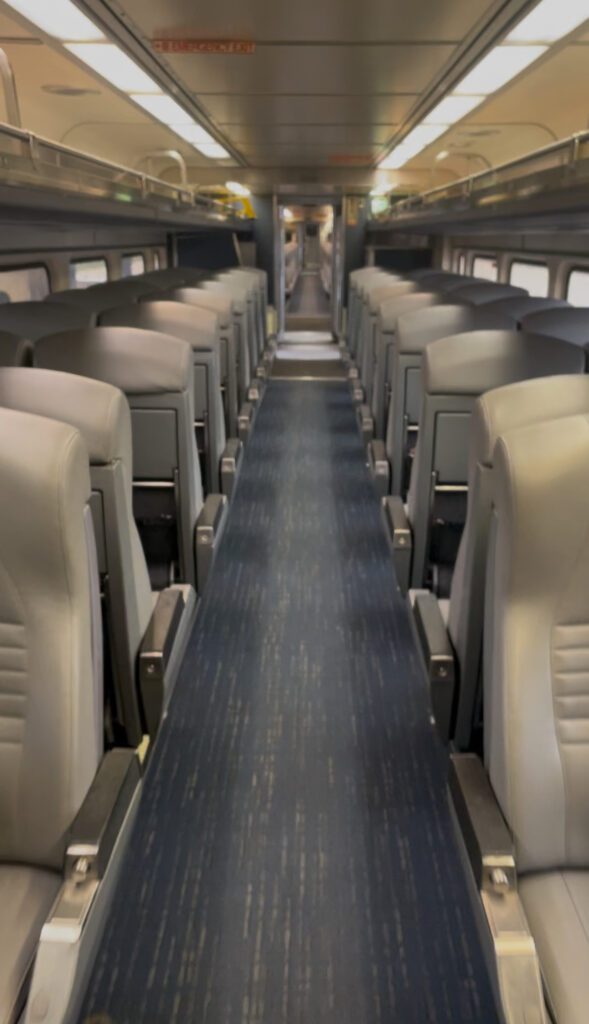
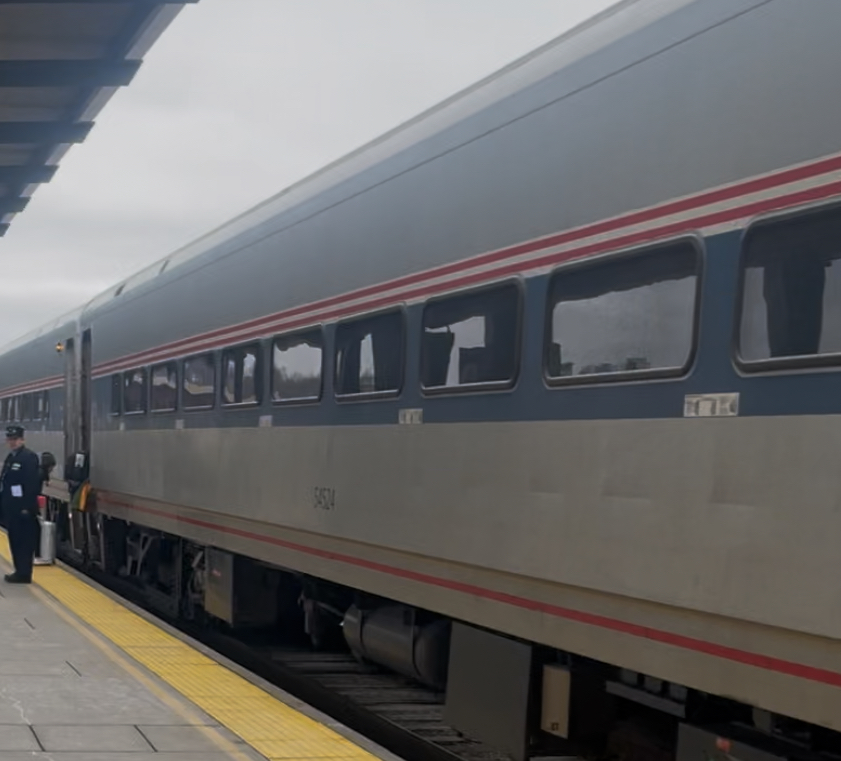
“Borealis Line 1340 to Chicago boarding now,” comes the cry of an Amtrak employee, initiating a march of shuffling feet from white marble floor to grey concrete to the blue-carpeted interior of a train car.
A brief time later, a soft, almost imperceptible lurch signals the beginning of a journey over 100,000 have taken since Amtrak opened its new Borealis line in May 2024.
This line serves passengers from St. Paul to Chicago and makes stops in Winona (Minnesota), Milwaukee (Wisconsin), Glenview (Illinois), and eight other towns on its nearly seven-and-a-half-hour journey.
A mix of transportation and sightseeing made the Borealis an instant success. In its first full month of activity, the line had over 18,250 passengers, an encouraging sign for Amtrak. Even more importantly, the line has had sustained success.
“[The level of success] has been a little bit surprising, honestly,” said Kevin Roggenbuck, senior transportation planner at Ramsey County Regional Railroad Authority in Minneapolis, Minnesota. “MnDOT people thought ridership would drop off a bit after the summer, and while there was a bit of a drop in September, October saw numbers about the same as the summer.”
In contrast to some of its Amtrak counterparts, such as the 45-hour-long Empire Builder, the Borealis line is more focused on transportation than tourism.
“[The Borealis line] is unique in that it’s what’s called a ‘state-supported service,’” Roggenbuck said, “What that means is that the Borealis line, and any routes that are 750 miles or shorter, must be funded by the state where it runs.”
In an interview with Fast Company, Ray Lang, vice president of Amtrak State Supported Services, said “What we’ve done here is increased the level of utility and become a more relevant transportation provider.”
While transportation may be the catalyst for its creation, the Borealis offers an experience distinct from America’s car-centric culture — according to the U.S. Department of Transportation, the vehicle remains by far the dominant form of intercity travel in the United States.
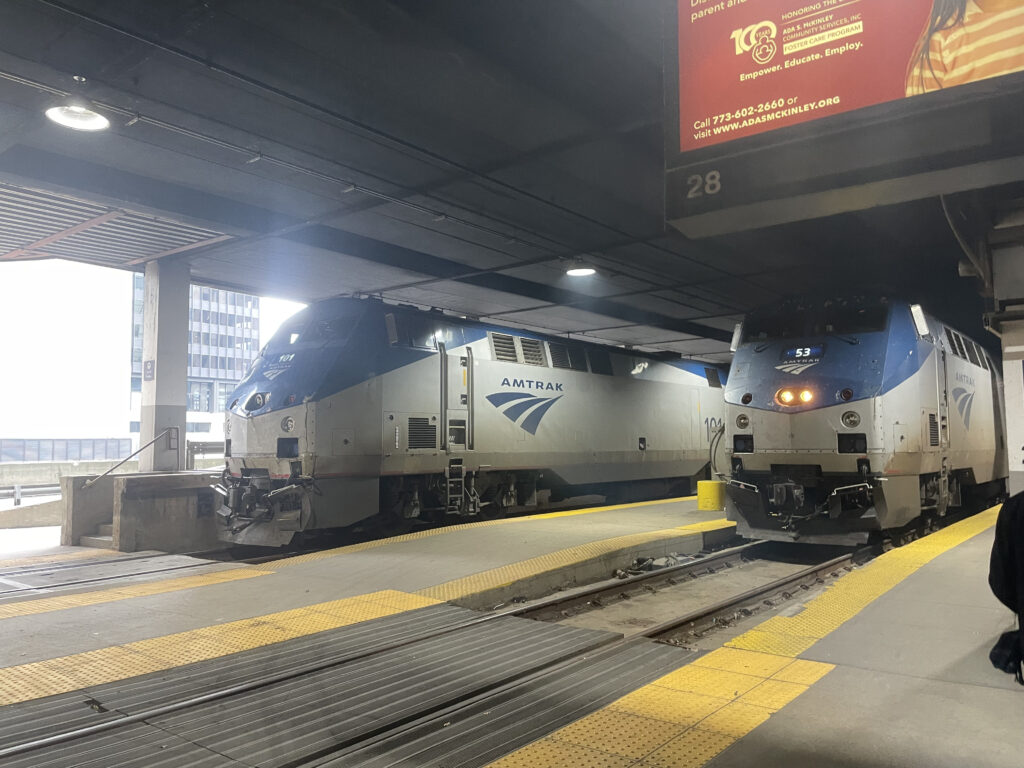
In the journey’s initial stages, road and rail run parallel. Passengers on the Borealis can observe as vehicles travel back and forth on Minnesota’s Highway 10. Further east, however, the path diverges.
In eastern Minnesota and western Wisconsin, the Mississippi River’s choppy currents come within feet of the train’s spinning wheels while pale green hills rise and fall across the shore with each passing moment.
When not on the river’s banks, the Borealis whistles through dense forest, aching valleys, and lachrymose, isolated towns. A muted red and blue bar at the end of an empty block in one such town in Wisconsin greets passengers with a flashing neon sign reading “Bottoms Up.”
The train’s new success is also evident inside the cars – once all passengers were boarded in St. Paul, the Borealis was already nearly full. Even though passengers were lost at stops along the way, the train completely refilled – with no seats left to spare – after stopping at Milwaukee’s Intermodal Station.
Another factor crucial to the line’s success is its convenience. The Borealis line runs every day from St. Paul to Chicago, allowing riders to feel more confident in their ability to travel on time.
“The convenience of having options, the ability to take day trips, and the better on-time performance, I think, are the three most important factors that make the Borealis an attractive train to take,” Roggenbuck said.
He said the ability to create this new line was largely due to federal funding from the Biden administration.
“When Biden was a senator in Delaware, he would ride the Amtrak to and from Washington, and so he became an advocate for it,” Roggenbuck said. “When he became President, he passed the Infrastructure Investment and Jobs Act, which opened up a lot of funding for new passenger trains, like the Borealis line.”
As night falls, Chicago’s vast, towering skyline is clear, even from the Borealis’s milky windows. Once in the city’s bowels, the train finally pulls into Chicago’s Union Station. As the stream of passengers dissipates into the city, Borealis Line 1340 begins preparations for the next day’s journey back to Minnesota.
For Amtrak, future journeys are a bit hazier, as the result of November’s presidential election throws doubt on prospects for additional funding.
“A lot of these funds for the next couple of years are very difficult to reverse administratively, so they’re kind of guaranteed,” said Roggenbuck. “As for the long-term prospect of more of these grants coming out in 3 to 4 years, that’s more unsure. I don’t think there’s been an emphasis for the new administration to keep developing passenger train routes. We’ll just have to wait and see how it goes.”