
Not all things from our parents’ generation need to go. That little old church on the hill should stick around.
This article includes an optional audio read-aloud for easier accessibility.
The red brick church called Holy Cross sits on a low hill surrounded by prairie grass in Maxwell, Iowa. Few sounds can be heard here, save for the sporadic chorus from gray herons and pheasants, and, every Sunday, car tires churning over gravel and old friends chatting as they make their way up the front ramp.
For more than a century, a loving community has gathered inside this rural church. It’s Roman Catholic by affiliation, but its spirit belongs to its neighbors. Come as you are to Holy Cross.

Photo: Emmett McMenamy
“My grandmother used to call us ‘small-c’ Catholics,” says Laurie Phelan, a 64-year-old lifelong parishioner who lives pretty much across the street. “That means we’re not about the dogma — we’re about the word ‘catholic,’ which means everybody’s welcome.”
For a generation looking for connection, that may sound pretty good.
Come on In
Gen Z is hesitant about social interactions; as a result, we report lower levels of happiness than older adults, according to a Stanford report. We underestimate the friendliness of others and often shy away from one another. But rural churches like Holy Cross, with pews emptying like their rural surroundings, want to welcome us in. They need us just as much as we might need them.
Here, you will be quickly known. The congregation of Holy Cross remembers your name. It’s a small gesture, but it makes a newcomer feel… at home.
Casey Meeker began attending Holy Cross with his spouse, Shelby, when they moved to the area a few years ago. They knew about the little church that stood alone amid grassland and decided to visit because they preferred the 8 a.m. Mass — a valiant move for a Sunday morning.
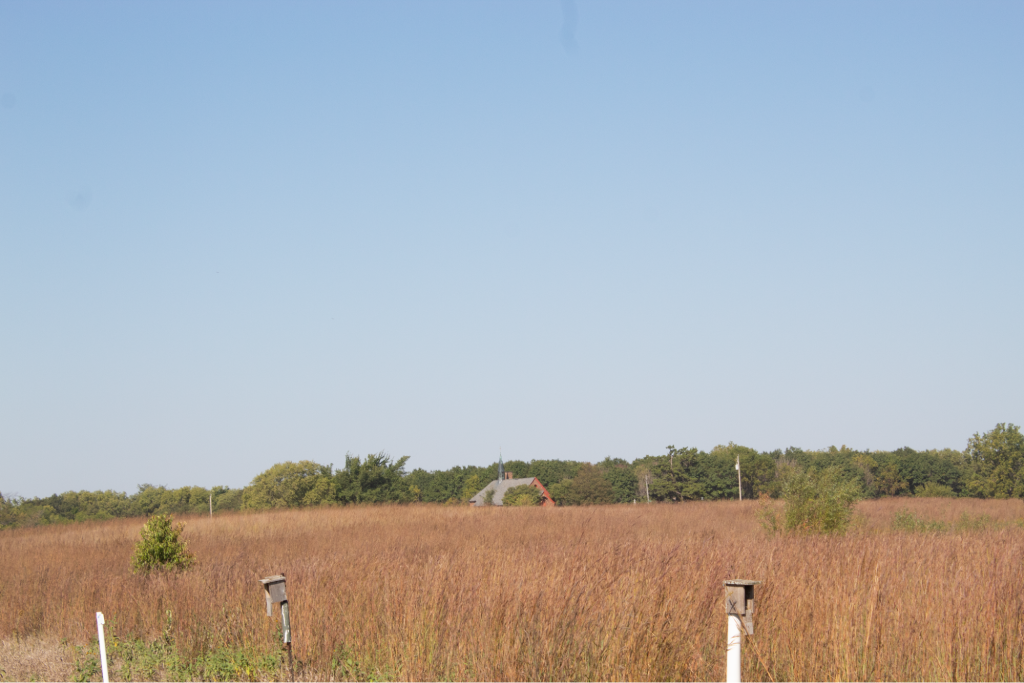
Photo: Dashae Engler
“They were very welcoming right away,” Casey says. “Everyone would say ‘hi’ after church, and we got to know them.”
By their third Mass, the priest at Holy Cross was greeting them both by name and blessing their son Jax as they stood at the altar for communion.
“We completely bought into what they built and what they wanted for this church, because it so aligns with who we are,” Shelby Meeker says.
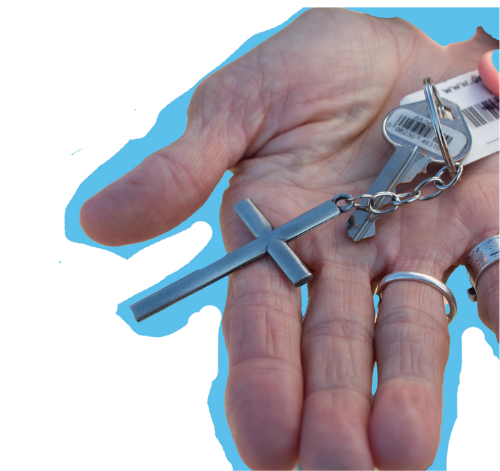
Photo: Dashae Engler
In a world of passwords and keycards, this jewel box of a church insists on a tradition of open access for all who may need it — community members new and old. In fact, if you want to join, you get a key of your own.
When Laurie’s late father, Patrick Phelan, was the church caretaker, he left its doors unlocked so anyone could enter at any time. That policy didn’t fly with the insurance company, so he switched to hiding a key under the doormat and eventually just handing them out to new members.
Keepers of the Tales
Maybe the thought of a small rural church is boring or frightening for you — after all, only 11% of our generation is churchgoing weekly, and the headlines aren’t always good. But considering 73% of Gen Z sometimes or always feel lonely, a rural church community that’s into hosting you for dinner and taking your kid on playdates might be worth a shot. It worked out for the Meekers.
“If it holds value to someone else, you almost want to join and keep it going for future generations to enjoy as well,” Casey Meeker says.
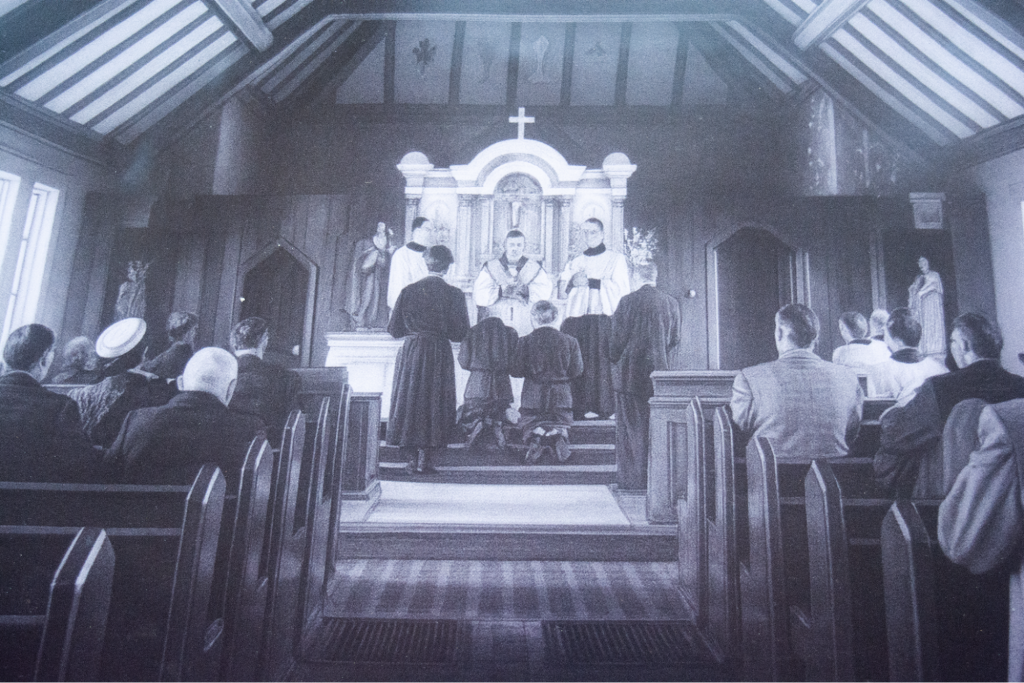
Photo: Emmett McMenamy
If you stumble across a little church — say, in corners of the central Midwest like St. Ann Catholic Church in Washington, Missouri, or Holy Ghost in Dickeyville, Wisconsin — you’ll notice humble and holy architecture and striking geographical placement. Holy Cross sits as a sentry overlooking thousands of prairie acres. But when you walk through the front doors, there’s an immediate feeling of being part of something bigger. And that something is history.
Every corner of Holy Cross has a story attached to it. Laurie Phelan walks outside the church her father tended, which she tends now, and points toward the surrounding land left undeveloped to preserve the prairie, timber, and wetlands, now part of an 8,000-plus-acre county park. Church leaders worked to protect the same views that a settler may have seen coming to this place more than 150 years ago.
Photo: Dashae Engler
Irish immigrants built Holy Cross in 1875, and they centered their lives around the practice of loving their neighbors. They fought for each other and their parish. When the Ku Klux Klan burned down the church in 1927, a parishioner paid $18,000 to rebuild (more than $300,000 today), with no help from the local bishop. More recently, another parishioner fought against pushback to plant American flags in the cemetery so people could honor veterans they know.
Laurie moves through the sanctuary, pointing to the marble altar, with its striking carved depiction of the Last Supper, shipped from overseas so immigrant parishioners might have something from their first home. She points to a reliquary holding a fiber from the holy cross of Jesus, which came from Holy Cross Abbey in Ireland — the boyhood parish of a parishioner generations ago, and the inspiration for the church name.
“Christ was a storyteller,” Laurie says. “[He told] parables all the time. We’ve got to tell our story.”
Little Communities
Lynn Schreurs drives a half hour from a Des Moines suburb to Holy Cross every Sunday to find what he’s looking for at the end of every week: a peaceful Mass and a tight-knit community of people who care.
“I’ve attended Mass at a number of the larger churches,” Schreurs says. “But they’re like people in the shopping mall. They’re not looking in your face and greeting you [or] caring about you.”
Like Schreurs, young people are looking for community. When the extent of someone acknowledging you is two taps on an Instagram post, a rural church could offer something more. But small churches like Holy Cross are a diamond in the rough — Axios reports that 15,000 churches could close this year, with rural churches at high risk.
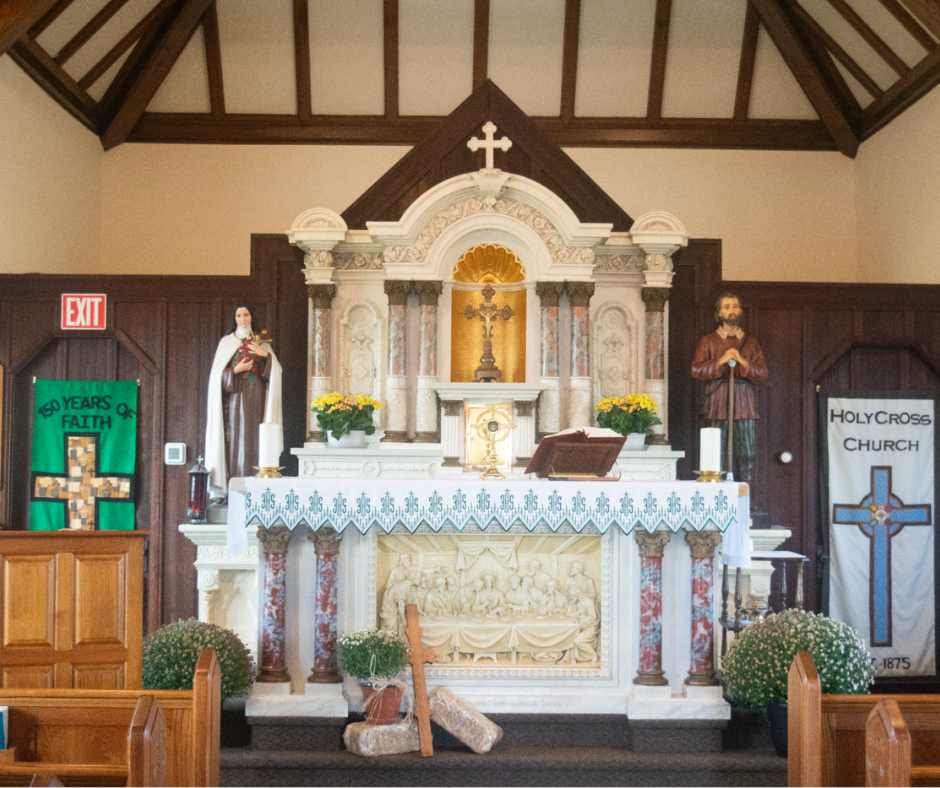
Photo: Emmett McMenamy
When those churches close, we lose a community where we’ll never go unnoticed, especially in places like Holy Cross, where the Sunday capacity is 88 people. For a generation that’s been warned to guard its privacy since they grew up with a cell phone in their hand, it seems counterintuitive to want to be known. And yet, we do. Casey Meeker says Holy Cross wants his family there, and it’s almost like going to church with your actual family.
“The congregation is invested,” Shelby Meeker says. “We never feel judged. Going to a new Mass or a different congregation, you never know how they’re going to feel with the noisy kid… It’s never been an issue at Holy Cross.”
When the congregation is supportive, you don’t have to worry about your perception, as young people tend to do. The Meekers can participate in Mass and be parents with no added social anxiety.
These types of communities can even empower. Nathan Linton, a 30-year-old Catholic Capuchin priest who grew up in rural Cumberland, Wisconsin, remembers when the entire town attended a vigil service at the local Lutheran church for a community member who tragically died. In these communities, you never have to go through something alone.
“When you’re in a big city and you don’t have that same sense of community, you’re not going to see those same kinds of things,” Linton says.
The biggest problem in a rural church like this is losing the population that built it. Rural populations are aging. Young people are moving away. The majority of Iowans moving from rural communities are people aged 25 and under and workers between 45 and 64, according to a report from Iowa State University Extension and Outreach. When families leave, churches can close. As the Christian phrase goes: If your church isn’t crying (children’s tears), it’s dying.
One rural community on the negative end of this decline is St. Mary’s in Hamburg, a small town in southwestern Iowa. Because of flooding, school closures, and rural flight, the population has dwindled from 2,000 residents in the 1950s to below 1,000 now. St. Mary’s 30-year-old priest, Rev. Jason Lee, says that in towns like this, the church — the beating heart of such communities — is the last thing to go.
“The bars will close down, the other businesses will close down, the meat packing plant for the meat locker closes, banks close,” Lee says. “But as a society, when they lose that church, especially a small, rural community, it devastates them.”
That’s because when a church closes, what’s lost is a region’s history, tradition, and culture. It’s the pillar that held up a people as they were born, married, celebrated, died, and mourned.
“It’s not even about the building or the church,” Shelby Meeker says. “You’d just lose the importance of community.”
That community is something we’re desperate to find.
Walking in Faith
Laurie Phelan paces through the Holy Cross cemetery adjacent to the church, pointing out headstones. She notes the gravestone of original immigrants and her ancestors. She pauses at the grave of her father, Patrick Phelan, who instilled the Holy Cross culture in her. Laurie’s blank headstone awaits her here, too. And in this cemetery, she points out the neighbors who aren’t Catholic but wanted to be here with their old friends.
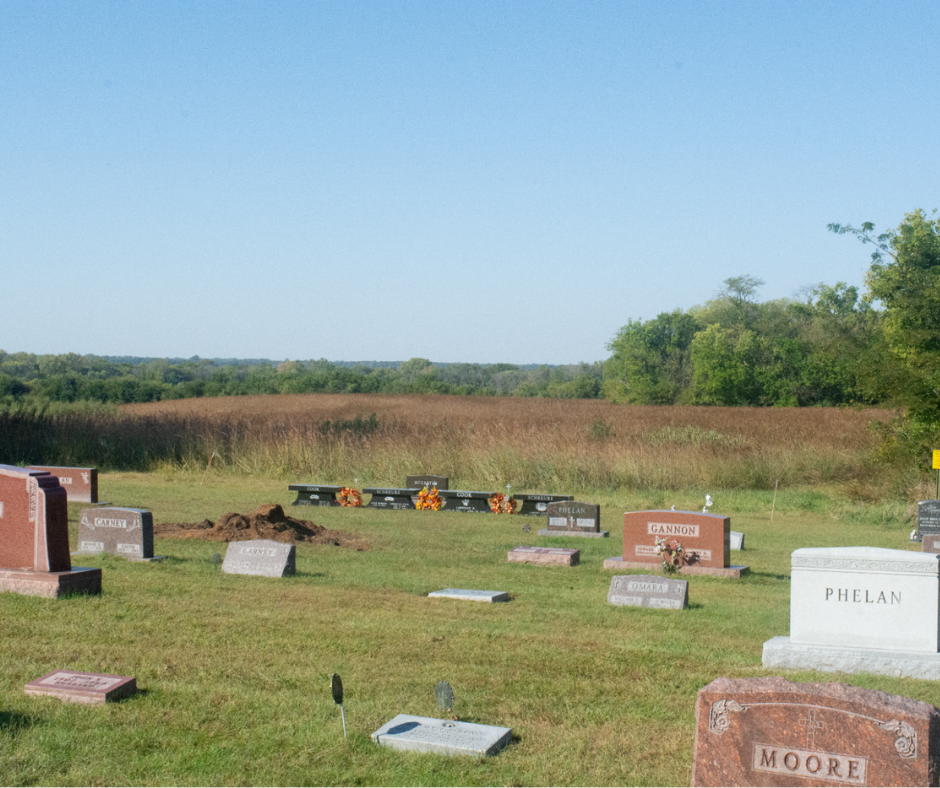
Photo: Emmett McMenamy
Right now at Holy Cross, Laurie makes sure that anyone can be buried in its cemetery, following in her father’s footsteps of open access.
“If we’re being good Catholics, good Christians, we’re going to welcome with open arms anybody who wants to practice their faith,” Laurie says. “If it’s something we can offer here at Holy Cross, like this church, our cemetery, [or] one another in conversation, that’s what we should do.”
A powerful nod to Holy Cross’ open arms came when a group from the World Food Prize visited in 2015. This organization, based in Des Moines, honors people who have made a significant impact on improving the quality, quantity, or availability of food in the world. At the time, the World Food Prize was hosting international visitors, and they were looking for a place where conservation, faith, and farmers worked together. They were directed to Holy Cross.
Patrick Phelan greeted them at the door, as he would to anyone who stopped by. He invited them in, saying Holy Cross is open to all. And in this charming little church, Laurie Phelan’s mother played “Amazing Grace” for these visitors, as she did for the congregation over the decades.
“They [all] sang,” Phelan says. “Dad said it was so beautiful, and we all cried.”