
From small-town regulars to late-night travelers, gas stations like Casey’s have become a shared part of Midwestern life.
This article includes an optional audio read-aloud for easier accessibility.
Every region has its quirks, but only in the Midwest has a gas station evolved into a mandatory stop, beyond the purpose of fuel. Gas stations are the Midwest’s unofficial community centers, and Casey’s just happens to be the place where caffeine, gossip, and comfort food collide at 7 a.m. sharp.
When on a long road trip, awaiting the nearest stop, the anticipation is never-ending, as you have been trapped in the car with your family for what feels like forever. The beacon of hope is the big blue exit sign that shows the upcoming stops, inevitably including Casey’s logo. A warm piece of pizza, fresh soda, and a quick freshen up in the bathroom bring long-awaited relief. For a moment, everything is okay. Casey’s is the ultimate home-away-from-home, Midwest style.
Sure, chains like Kwik Trip, Maverik, and Git N Go shape much of the convenience store landscape across the Midwest. But Casey’s stands apart in one crucial way— their footprint on small and mid-sized towns that most national chains bypass, focusing on bigger cities rather than the Midwest’s rural areas. Casey’s operates not just as a fuel stop, but as an essential community space that is woven into day-to-day life within rural and Midwestern areas.
Despite other chains having more locations in the Midwestern states, one fact stands true: Casey’s is a consistent favorite in Iowa, Minnesota, Nebraska, North Dakota, and South Dakota.
It doesn’t come down to who sells gas – it’s about who becomes a part of customers’ regular routines, transforming a quick stop into a community hub. For many, growing up in the Midwest means countless quick runs for gas and snacks that turn into reunions with old friends or 15-minute long conversations in the parking lot.
The Heart of the Midwest
Casey’s began in 1968 in Boone, Iowa. Soon after, the gas station transitioned into a convenience store. In the Midwest, gas isn’t always the first thing we think of when it comes to Casey’s. Rather, it’s breakfast pizza and the dizzying array of snacks inside. Seriously, try explaining this to someone from New York; the bodega is not the same as this.
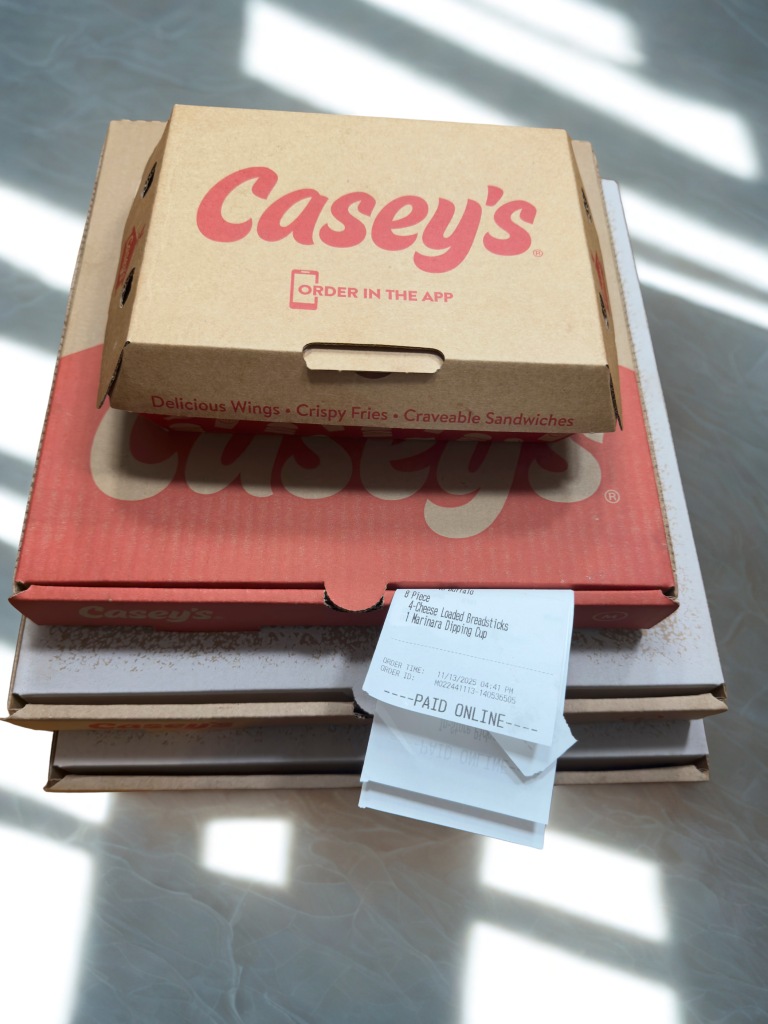
Photo: Madie Moro
You’ll probably end up feeling a little sickly full after all the snacks and food options – I know I have. And when you leave with your arms overflowing with treats and they offer you a bag, the obvious answer is still to carry it all out and struggle on the way to your car. The smells of fresh coffee and breakfast pizza fill the air all around the building. Upon walking up to the gas station, as always, a stranger is holding open the door, asking how your morning has been so far.
Many who pull into the Casey’s parking lot are in a hurry to get started with their day, like they’re late for a NASCAR pit stop, while others stay inside chatting for ages. Everyone inside exchanges quick hellos, small talk about the unpredictable weather, and a full recap of what’s going on around town. Despite the people inside being from all different walks of life, it brings together school employees, college students, salespeople, and even farmers. It’s a combination of folks not often seen together.
Filling the Gaps: Rural Food Deserts
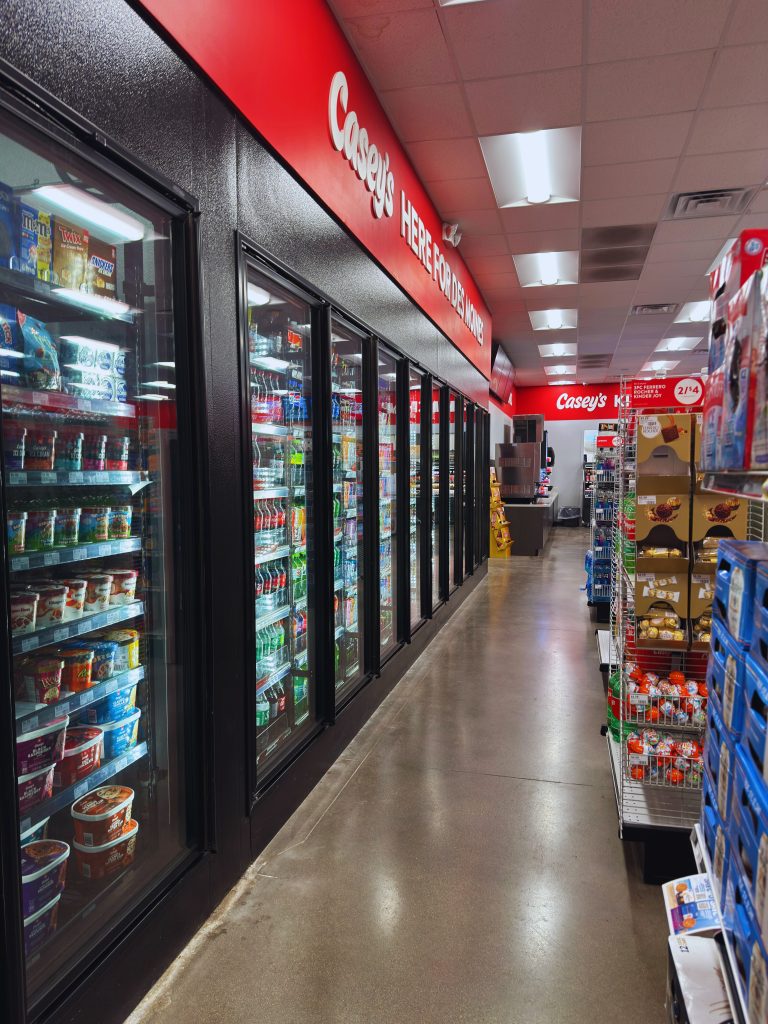
Photo: Madie Moro
In many small and rural towns, gas stations have become a lifeline. Areas where grocery stores have closed their doors for good — or never even existed — are called food deserts. For residents without easy access to a local supermarket, these gas stations serve as a primary source of food. The shelves are stocked with fresh produce and hot meals that are quick and ready to go.
Saying Casey’s plays a role in keeping their community connected to basic necessities would be an understatement. Laree Renda, a Casey’s board member, says that the small-town feel is very intentional.
“About half of our stores are in towns of 5,000 people or less,” she says. “For those customers, Casey’s is not just the local gas station.”
In these smaller towns, Casey’s serves as more than a convenience. Angie White, a resident of Elkhart, often stops by her local Casey’s since there are few options for prepared foods in her area. White says that she often picks up pizza for dinner because, “It’s an easy meal when you are on the go.” Filling the grocery store gaps of her town in Elkhart, Iowa, which doesn’t have a grocery store within 18 miles. “The gas station is friendly and consistent,” White says.
“The chains all look the same and have similar product and service qualities,” she says. “Casey’s has become more than a pit stop in my week.”
This consistency is not just comfort; it is the bridge to fresh foods with limited travel.
“Even though we do not explicitly target the food deserts, our model naturally fills those gaps,” says Chad Bruntz, investor relations manager at Casey’s. “We take pride in being able to provide those essential products and services in smaller towns.”
Casey’s Online Fame
Everyone has their go-to gas station order. Some grab a daily cigarette, others a box of potato bites, and some can’t resist a whole pizza. Whatever the craving, Casey’s has got something for your late-night bite after drinking, and also for the mom driving around her kids’ soccer team.
A defining Midwest tradition is trying the well-known pizza. The priority is at the top of everyone’s list. It was introduced in 2001 and has only gained popularity since. Casey’s continued to expand its scope through its coffee and additional food offerings. It’s the closest thing the Midwest has to a peace treaty. We demand and they deliver.
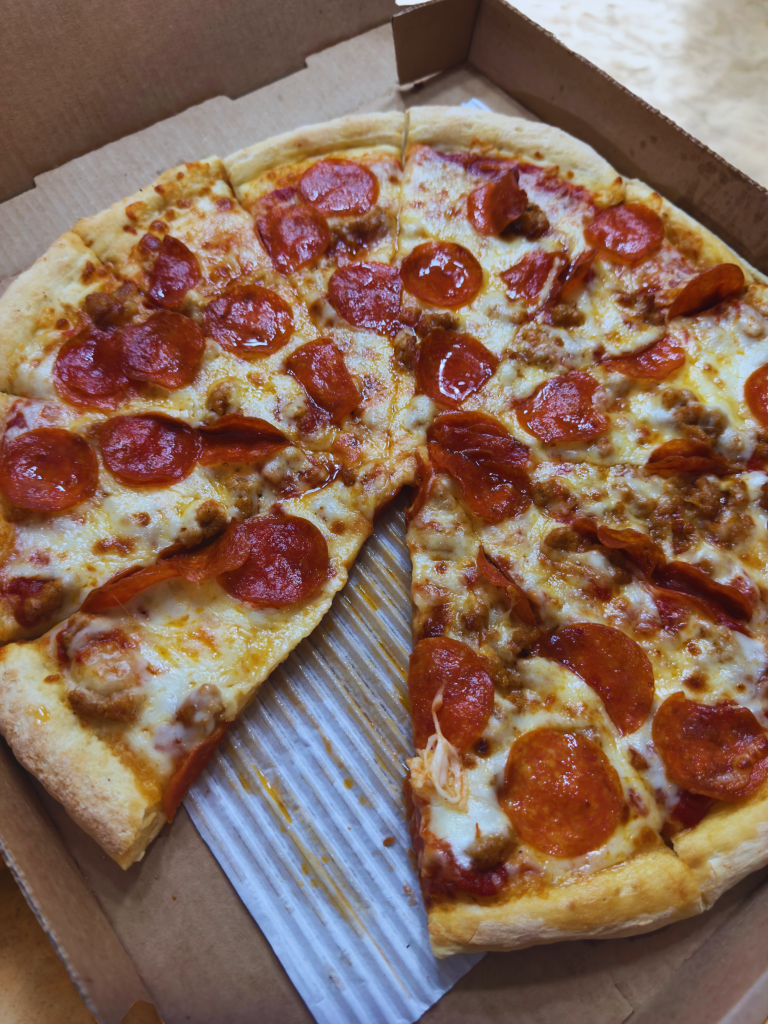
Photo: Madie Moro
Social media trends about pizza are constant. The slamming of pizza boxes to test their grease absorbency began on TikTok and has become an online phenomenon. Upon first seeing this trend, my immediate reaction was: Why are these people slamming their pizzas down to the ground so angrily? TikTokers visiting the Midwest often try different slices, host taste tests, and spark debates over which options reign supreme.
Matthew Wurnig is most commonly known for his viral 50 Dates, 50 States TikTok series. He travels across the country, going on a date in each state, amassing a following of over 700,000, and has been a Casey’s pizza fan from his first bite.
“Casey’s being a part of that Midwest culture brings out a lot of passion in people,” Wurnig says. “What separates Casey’s from other gas stations around the U.S. is their unique pizza options. When I first got introduced to Casey’s, it was because people raved about their breakfast pizza.”
Wurnig is not the only one who has viral posts surrounding the Midwest delicacy that is gas station food. When Filip Johansson moved to Iowa from Sweden, he was quickly met with Iowans urging him to try Casey’s.
He has filmed videos trying a wide variety of items from Casey’s, including Scotcheroos, puppy chow, and, of course, the pizza. In one of his videos, Johansson initiated a challenge of only eating Casey’s food for 24 hours — talk about commitment.
Casey’s has become a cultural anchor, bringing people together — and yes, stirring up some delightfully controversial opinions along the way. Those controversies often focus on the best menu item and which items are worthy of being left behind.
Cultural Offerings
Only in the Midwest can you stop for gas and walk out with Mexican food, wondering what you went in for in the first place. A recent addition to the menu is the Chorizo Pizza. The pizza was actually discovered during an internal cooking competition, making its way to the real menu. Following the pizza, they also added aguas frescas, a traditional fresh Mexican drink.
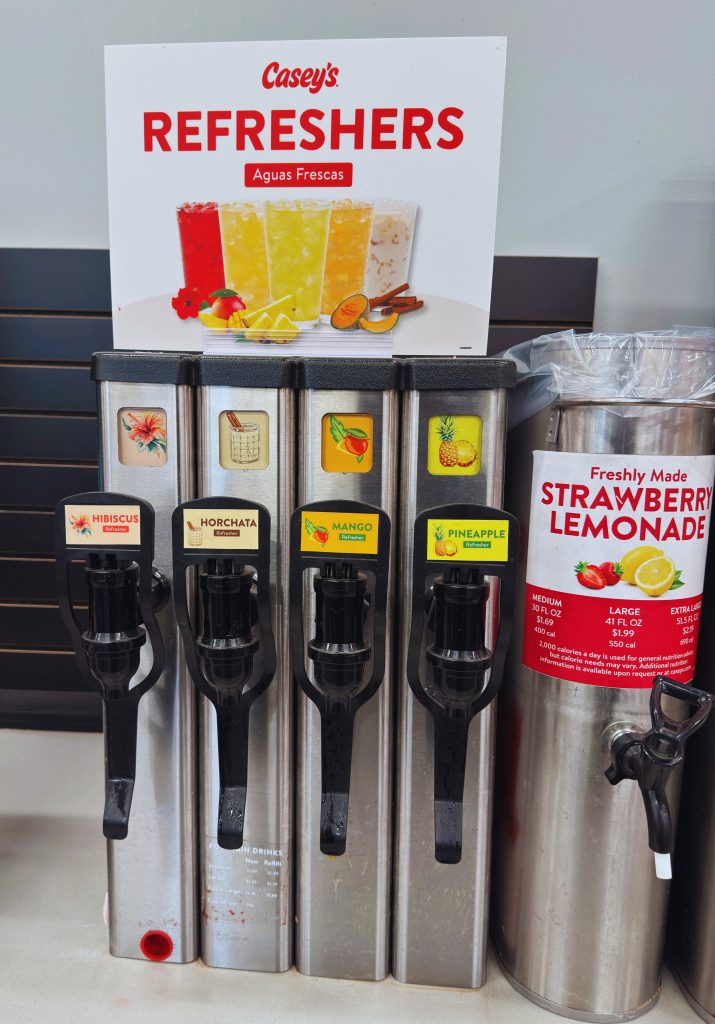
Photo: Madie Moro
“Especially in this political climate, where people are being persecuted for being from different backgrounds, it feels nice to know that our culture is still appreciated in some places,” says Sol Salas, a Des Moines resident of Mexican heritage. “I think someone walking in and seeing these offerings would feel a little more comfortable.”
Samantha Foster from Australia says that whenever she and her family visit the U.S., Casey’s is now a mandatory stop. They first came to the Midwest to watch sprint car racing at Knoxville Raceway. When stepping inside Casey’s for the first time, she found it to be “immediately handy.”
“Our convenience stores are different,” Foster says. “We can’t buy alcohol at convenience stores in Australia, and they are not open for long hours.”
As she spent more time inside the store, the differences did not stop at the hours or the overall atmosphere. They continued, right into the food warmers. Her go-to Casey’s order is breakfast pizza and a soda.
“We can purchase food within our convenience stores in Australia, but it is things like pies and potato cakes,” Foster says.
Casey’s pizza has settled into its own weirdly beloved corner of Midwestern cuisine. It’s not New York-style, and it’ss not Chicago-style, and it’s definitely not posing as such. Ranch and marinara sauces are part of the deal, don’t fight it.
The pizza itself is similar to a deconstructed calzone. There is no crumble, but it might almost flop out of your hand, with a generous layering of toppings and variety within. It is hearty and heavy in a comforting way. It’s practically the pizza version of that Midwest friend who insists that you take leftovers home, no matter how many times you say you’re fine.
“Roughly two-thirds of our gross profit comes from inside the store, which is actually higher than most convenience stores,” Bruntz says. He thus confirms what everyone already suspects. At Casey’s, the food is not a side gig — it’ss the main attraction.
Evolution Beyond Food
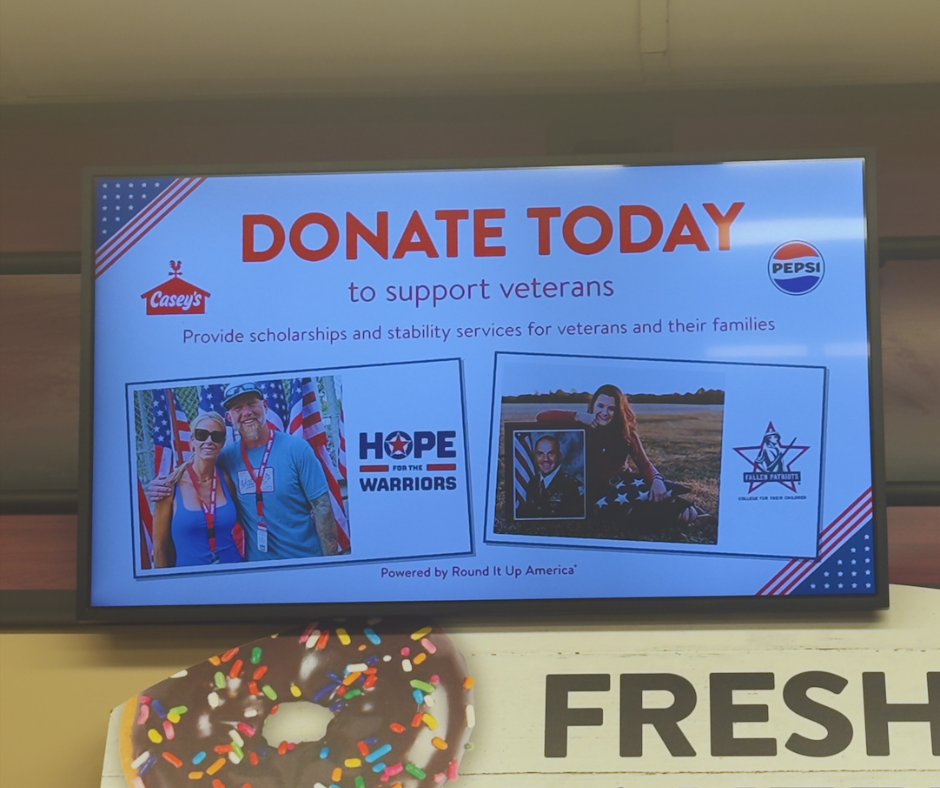
Photo: Madie Moro
Casey’s employees have a subreddit where they discuss their experiences with the company. Employees frequently post photos of their handmade donuts, showcasing the different seasonal designs like pumpkins, spiderwebs, cotton candy, and flowers. This has inspired others to share their donut creations as well.
Others use the platform to share their complaints about the chain. Employees asking for interview advice, wishing they could work different hours, and sometimes even wanting overtime. But these workers, throughout the good, the bad, and the ugly, have found a way to connect with one another outside of the store.
Through traveling to the many different Casey’s, there were many times that I witnessed personal interactions between customers, and nodded my way through different conversations.
As I was going inside Casey’s in Des Moines on Veterans Day,there was a man sitting outside with a sign saying “homeless, anything helps.”A state patrol officer walked inside and looked urgent. Was he going to tell him to leave? He hurried through the aisles buying enough to fill an entire sack. He finally finished up and headed outside. Handing the man a bag containing essentials and some food. He patted him on the back. Then went back to his patrol car to return to work.
I was greeted instantly as I walked into different locations. Casey’s shoppers held the door open for me and asked about my plans for the day. In the smaller towns, there were more confused looks. Probably because their town’s total population is about 500 people. And they were wondering who this random lady walking around with a camera was.
But they are not only welcoming to those within the stores — this feeling also expands outside of the store. Casey’s mission is “to make life better for communities and guests every day.” But does this actually play out in the community?
An employee in Osage Beach, Missouri, says that the culture within Casey’s spans beyond the doors. “We also have food banks that we sponsor, and we have a lot of different organizations where customers can round up for schools and local causes.”
Casey’s knows community is important to their customers, and this is exactly why its marketing revolves around this. The Casey’s “Cash for Classrooms Grants” can be donated using their in-app reward system, directly from the customer’s rewards points if desired. Grants range in price from $3,000 to $50,000.
“We value that community connection,” Bruntz says. “In smaller towns, people might want to chat at the counter — and that’s part of what makes Casey’s Casey’s. It’s about reflecting local tastes. As we expand further south, we’re mindful of what works regionally while still staying true to the Casey’s brand.”
Edvin Ljakic, a regular at Casey’s, says, “The vibe of the Midwest feels just right after living here. Midwest gas stations, depending on the time and area, feel safer and cozier compared to other places in bigger cities.”
Ljakic’s experience as a customer reflects the welcoming atmosphere that Casey’s has become known for, and it is something the company intentionally strives to preserve.
Casey’s journey mirrors the people it serves, rooted in tradition but open to change. As the brand evolves beyond the Midwest, the story becomes one of connection, culture, and care. Whether through a chorizo pizza, a friendly smile at the counter, or a donut posted online, Casey’s proves that a sense of community can travel just as far as its brand and spreads an unmistakable Midwest-nice feeling that customers leave their stores with.
“The Midwest brings together a hardworking community,” Ljakic says. “Early mornings or late nights, you can rely on Casey’s. Regardless of the time of day, the food is made with love and care.”