
The oldest pantomime troupe in the Central Midwest proves that the weirdest form of self-expression might be the most liberating.
This article includes an optional audio read-aloud for easier accessibility.
Many people stroll right past the silent figures in black tights at the farmers market in West Des Moines, Iowa. The August heat, with its thick Midwestern humidity, is the culmination of the growing season around here. The market puts on a show of almost lewd abundance that makes it tough to compete for attention. But there, among vendors, couples, kids, and dogs, is something unlike.
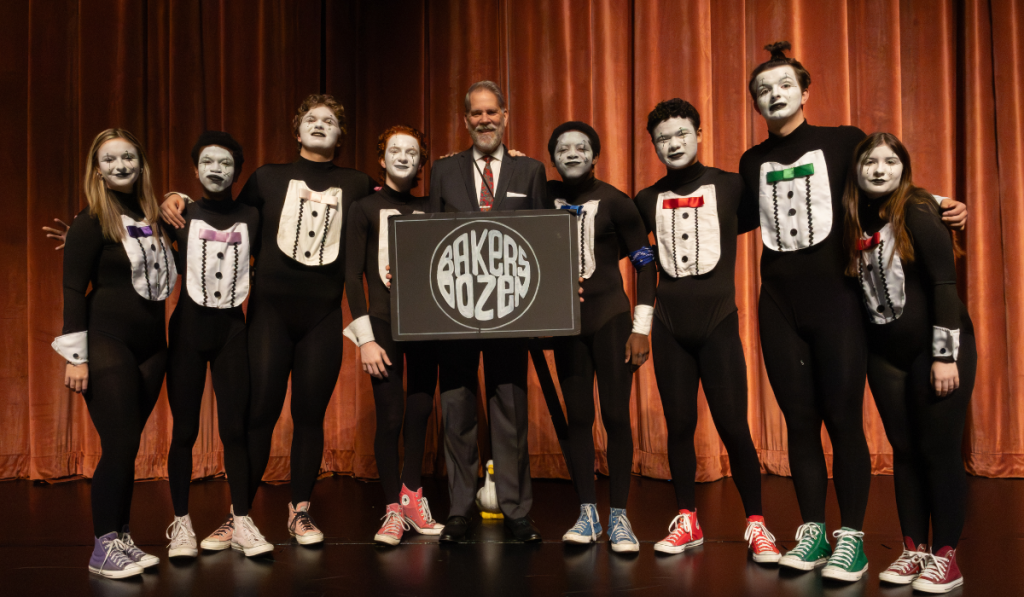
Their faces are painted white, each has a color-coded bow tie and a pair of matching Converse, as if they are “Among Us” crewmates. A circle forms around them. Right below the aged Historic Valley Junction sign, a few are run over by invisible cars. The talent-show judge chooses himself. The crowd — yes, now there’s a crowd, and it keeps growing — is heartbroken when a vulturous fish swallows the hilarious and kind of charming worm without any remorse whatsoever.
With no props or change of costume, The Baker’s Dozen mime troupe drew the kind of laughs and gasps from market patrons usually reserved for the giant pumpkins and baby goats.
A Whole New World
Pantomime is an ancient form of art that combines elements of comedy and magic, ballet and circus, grand narrative and transformation. It’s been forming circles of interest for centuries, from ancient Greeks acting out scenes of daily life to the ever-entrapped, somewhat unnerving French mime in a striped tunic you’ll still see on the streets of Paris.
But pantomime is more than an outdated street art. Without language, without earthly identities, mime is an artistic expression with no cultural boundaries.
In the bustle of the market, the mimes made a simple street corner their stage, and people stopped. Suddenly, the most captivating thing in all that abundance wasn’t tangible or for sale. No one seemed sure how to react to the thrilling, purely nonmaterial art, so dissonant with everyday reality. Different. Definitely creative. Entirely authentic.
Becoming a mime is about learning to communicate in an entirely new way. It’s perhaps the most unique art form. Mimes don’t describe, alter, or preserve the existing — they shape a reality. It’s a language that’s universal but deeply personal. It’s also hard to censor, although it’s not like China hasn’t tried.
The art form comes from a multicultural place — the early Roman Empire (no wonder it won’t leave my mind) — and now has deep roots in the melting pot of modern cultures. America was bound to love pantomime. “Humpty Dumpty” (1868), recognized as the earliest mime act in the United States, has been performed more than 1,200 times. “Pantomime Quiz” (1947) became the first show in history to hold an Emmy Award for “most popular television program” in 1949. But the real age of mime didn’t start until the 1960s. Mime troupes were popping up all over the country. Maybe your parents remember Shields and Yarnell, who were featured on “The Muppet Show.” Marcel Marceau, the one mime you’ve definitely heard of, toured the United States more than 25 times.
And one of the oldest mime troupes in America is based right there, in West Des Moines, Iowa, the country’s quiet midpoint.
Tim Brown, the sponsor of the troupe and a Baker’s Dozen mime himself (class of 1975), says that in this cultural moment, the group feels like a phoenix rising from the ashes.
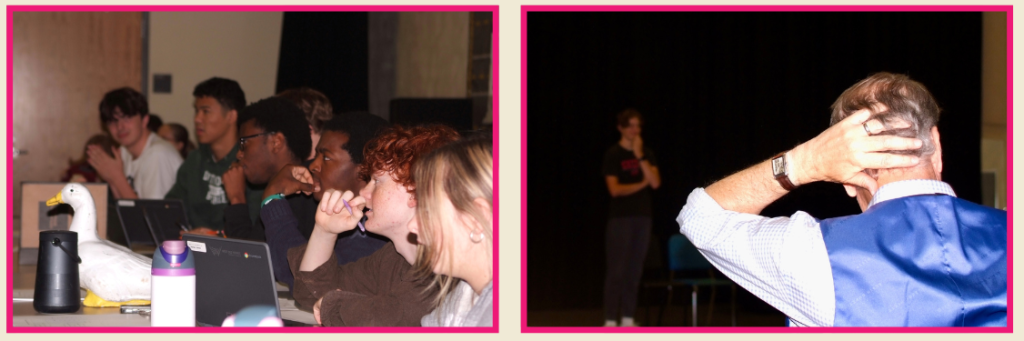
Photo: Mary Boldinova.
Hop Aboard the Mime-Mobile
Storytelling without words felt electric in a decade that questioned everything. Even a speech-class teacher in Iowa was into it. This story starts with her, Mrs.Van Dyke. She was the one who bribed Valley High School students to see a mime performance in 1968. And back then, student Jo A. Birdsall wasn’t one to say no to extra credit.
“What we saw riveted us and held us in a silent trance for over an hour,” wrote Birdsall in a letter to The Baker’s Dozen many years later.
One evening in a West Des Moines living room was all it took. Thirteen students came together united by their fascination with a silent art. Generally, starting a family in high school is frowned upon, but that baker’s dozen of Valley students did it anyway. And they’re still on the road (when class schedule permits). Today, it’s the only mime troupe that survives in the Central Midwest.
In the early 1970s, The Baker’s Dozen performed no fewer than 40 road shows each year. The competition for the troupe was serious, and their acceptance rate was comparable to that of Ivy League schools. “The Baker’s Dozen were the coolest people at Valley High School 50 years ago. Everybody wanted to be in The Baker’s Dozen,” Brown says.
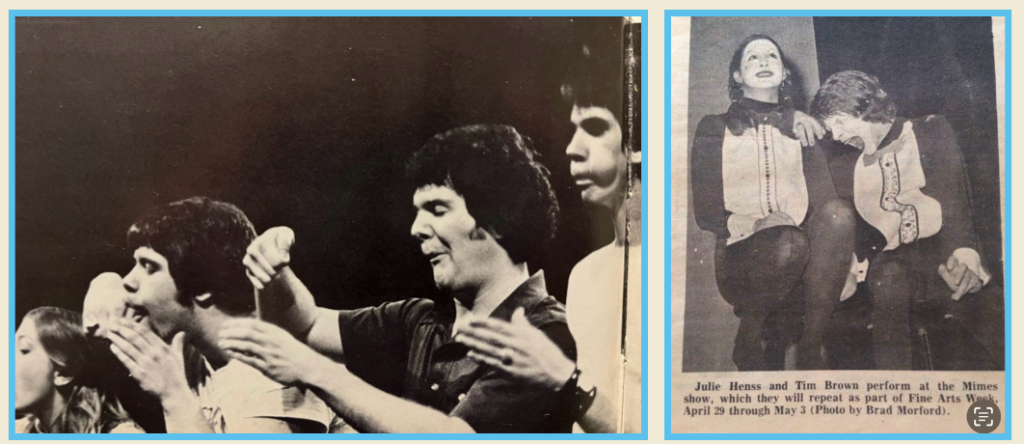
Photos from Brown’s personal archive.
And the chosen ones didn’t peak in high school. Peter Hedges, an Academy Award-nominated author and director, started as a blue mime. Spencer Griffin is a Baker’s Dozen mime turned executive producer who has worked with almost every major media company out there: Hulu, HBO, Sony, Amazon, to name a few. Amy Rhodes, the charming and hilarious star of “Amy at the Body Art Convention,” another troupe alum, wrote for “The Ellen DeGeneres Show” for five years. Then there are Sommer Austin, Ty Stafford, Jessie Hixenbaugh.
But the tech revolution and the pandemic weren’t kind. The world was changing, and pantomime wasn’t hot anymore at Valley High School, though it probably hadn’t been as mainstream as it was in those weird, experimental ‘60s and ‘70s. The troupe stopped doing road shows. By 2020, there were only two pantomime shows a year in Iowa — the Fall Nite O’ Mime and Spring Nite O’ Mime.
When Brown came back as a sponsor 50 years after his Baker’s Dozen presidency — “Has my life gone full circle?” — he put a big Mime-Mobile sticker on his black Jeep, and the troupe was booking shows again. The farmers market was their last road show of the whopping 14 they’d booked for the summer.
Tights Magic
“I look forward to putting on my tights every chance I can get, and I want to do it more and more,” says Hitch Ea-nasir VanDeventer, the green mime. It’s not an odd middle name — it’s a mime name. The Baker’s Dozen passes down accent colors through generations, but the peculiar names are special to each artist. “I want to get out there and mime. It’s my favorite thing ever, being on stage.”
2025 Fall Nite O’ Mime.
Photo: Courtesy of Lucy Thomas
It only takes a few minutes. What seems like a quick storm — all 13 mimes in a 10-by-10 bathroom — transforms a group of facetious, shy teenagers into artful impressionists. The transformation isn’t only visual, although it’s shocking how effortlessly they wear the black-and-white makeup. Once the tights, white bibs, and colorful bows come on, somewhat mythical and utterly unmistakable characters come to life.
“I’m like a completely different person,” says Elena Amadopolis Albanese, the purple mime. “I don’t care what I do, [and] I don’t care how embarrassing the stuff I do is, because it’s not me. It’s Amadopolis.”
The characters are as real as the artist behind them, but they could never survive in the real world. The invisible walls of pantomime we’ve all seen are patted with something the physical world hasn’t discovered yet. It’s trust, absolute and conscious. Shame to a mime is what disbelief is to a fairy. A minor leak, and the magic dissolves into thin air.
“You’re on stage, you’re in tights. And those tights hit different, especially the first time,” says Andrew Gilgamesh Bonkafo-Efofa, the lavender mime. The others nod at this. Yeah, they do. “You have to trust that the audience will let themselves be enveloped in the scene, and you have to trust the people who are in the scene that they will do their part.”
Turns out, pantomime is as much a discipline of the mind as it is of the body. Trust doesn’t always come easily. The mimes don’t always see eye to eye, and no one is free of judgment all the time.
“You have to trust that the audience will let themselves be enveloped in the scene, and you have to trust the people who are in the scene that they will do their part.”
Andrew bonkafo-efofa
The glue that holds The Baker’s Dozen together is a unique formula of learned intentionality, unconditional belonging, and familial love — a formula that’s been in the works for more than half a century.
Behind the Invisible Wall
Amos Bookasnook Hanser, the hot pink mime, is the current president of the troupe. On most Sunday nights, his basement is reserved for 14 — the mimes and their sponsor. It’s a tradition born long before Amos himself. The Baker’s Dozen mimes have been getting together in the president’s basement every Sunday for decades.
What if the president lives in a house with no basement?” I ask.
“You know, that’s the question, right?” Hanser responds. “And what if the president lives in the woods?”
I laugh, but he is not kidding.
“No, because it happened twice back-to-back,” Amos says. “Our dear president, three years ago, literally lived in the middle of the woods. The president, after that, her basement was getting remodeled for half the year.”
“That’s our ritual,” Hanser says. “We all bring a skit that we thought of throughout the week and pitch it to the group. A lot of times, we’ll have people get up and sort of visualize it.”
In true mime manner, there’s no need to sound the question. As soon as one starts a pitch, another mime jumps up to act out the narrative. Soon, six of them are in the center of the circle, stabbing, choking, and pulling each other’s hair. The pitch ends, and the mime pile comes crashing down with laughter and applause.
Someone quickly jots down the pitch. Over the course of weeks, the group creates hundreds of pitch cards and stacks them in a physical box. Simple. Analog.
The Baker’s Dozen pitch ideas in Hanser’s basement.
Photo: Mary Boldinova.
“We pitch our skits week after week and just keep going until it gets to one of our big shows,” Hanser says. “We put our best ones on stage.”
Not every idea makes it to the show or even into the box. Negative feedback is a pain point for many creatives, but Baker’s Dozen mimes know the value of their time — and a bright idea from a “PC” (piece of crap), Hanser explains. As craftsmen, they know it’s part of the process, and the path to success lies only through failure.
“I think it’s part of the reason why we’ve had a bunch of famous people here,” says Hanser. “You learn over and over and over again to think outside of the box.”
No one is here to preserve their ego, but the art. It’s hard work. “You’re not going to make banger after banger,” Hanser says. “So it’s just about always stirring up these ideas.”
The Baker’s Dozen is a well of ideas. They quietly share them with anyone who’s looking, free of charge. Hanser booked two shows the day we spoke, and Brown says Historic Valley Junction invited them back for future events. The farmers market crowd loved them.
Maybe that crowd was attracted to the oddity of simplicity among excess. Or maybe, if a farmers market is your idea of a good time, you are just looking for something authentic in this world. A few people in that crowd may have found the silent reenactment of life’s realities to be relevant, even universal. Maybe they’ll come back because the world has gotten too loud, or too silent. Or perhaps it’s just about how “same” everything can feel, with social media, artificial intelligence, technology. So much uniformity. Conformity. Conventionality.
Then, here comes the mime troupe.
2 responses to “Be Mime”
What a terrific ending! Reading about the Bakers Dozen’s journey through time, the family they built, and how they are able to preserve their art, creativity, and authenticity was so refreshing. Crazy how much talent came out of Valley High, looks like they got it right over there. Captivating story and so cleverly crafted!
Thank you, Mary, for your wonderful article. We all loved you being a part of our Bakers Dozen family. Just because you’ve finished your article doesn’t mean you have to be a stranger. There are thirteen (well, actually 14) of us who’ll miss you, so you need to keep in touch. You KNOW what fun we can be! There will always be a seat for you at the Nite of Mime shows. Thanks again for the great article and for doing so much to advance our little group.
-Tim