
Among the corn fields and dying small towns, Social Cinema is ‘making it.’
This article includes an optional audio read-aloud for easier accessibility.
Imagine being packed into a van with five other people for a month, making your way (and backtracking a bit) across the United States. You’re waking up early to hit the road, rolling off your friend’s couch, or, if you’re lucky, begrudgingly from a hotel mattress. If you’re unlucky, it’s a makeshift bed of blankets piled high on the floor, probably in a friend’s home, but also the homes of strangers or venues kind enough to let you stay.
Timing is everything, and you have dates to make. You have a soundcheck at 4 p.m. in a town two states away, but you’re late to hit the road after partying a little too hard at the show the night before. No worries, pack into the van and the drummer takes the wheel while you catch up on sleep or listen to that new release you’ve been waiting for. Don’t get too comfortable. Everyone takes a shift, and you’ll have to drive for a few hours through the stretches of farmland and prairies.
Now that you’ve arrived, it’s time to lug hundreds of pounds of equipment up numerous flights of stairs. Then you wait around for the audio engineer to call you on stage to check, check, check the sound.
Finally, you have some downtime — maybe a few hours before you’re called back to play. All that to stay up late playing in front of an unpredictable crowd — you’re not playing regularly sold-out shows, and you’re not exactly a household name (except maybe in your parents’ social circles). The crowds you play for are the occasional group of friends, but mostly locals. The venues come to characterize the cities you play in, and right now, the shows you’re playing are huddled in the Midwest. The collection of small venues scattered throughout the region is connected by stretches of road that scream desolation. But, when the music begins to play, people show up — whether there are 10 or 500.
You can’t be insulted by measly ticket sales; those days are bound to happen when you play in areas where Heydudes are hot and Drive Your Tractor to School Day is a real event. But the good days counteract that when you visit the shabby dive bar and are floored by the good-natured people in it.
Your trip around the region shows you the diversity that the flyover region has to offer. The exploration of local venues and conversations with townies reveal that people do care about music, not that you need the validation, but it’s nice to have some encouragement.
The life of a touring band isn’t glamorous. Maybe in a different time and a different place, it would have been a little more “Almost Famous.” But in 2025, in the Midwest, it’s far from sexy — at least not in a promiscuous, groupie, free-love type of way. It’s just, as most things are around here, a lot of hard work.
Meet the Band
Social Cinema is an alternative indie rock band from the Great Plains, with members hailing from Omaha, Nebraska and Wichita, Kansas — and they were my ticket to understanding a touring Midwestern band. I was going to tour with a band (well, follow them in a friend’s car, but you get the idea.)
Social Cinema’s music wasn’t the first thing that drew me in — it was opportunity. Who knew it would be so difficult to find a band (people you’ve never met) willing to let you tag along for a while and analyze their lifestyles.
Luckily, a friend pointed me to Social Cinema, and after some consideration, they agreed to have me along for three shows.
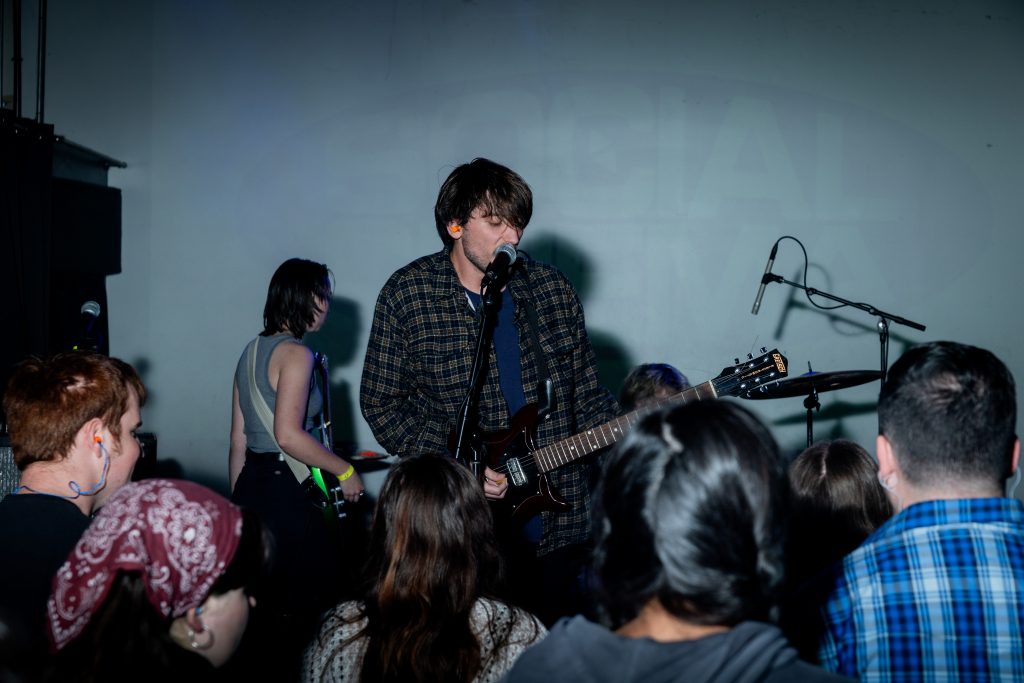
Photo: Baldomero Plate
Of course, they are a band and music is their priority, so after I secured my spot as the ragtag reporter, I listened to Social Cinema’s discography on Spotify. Phew, they’re good. Social Cinema plays well-crafted indie pop you can dance (or flail) wildly to. The tone and lyrics have a bite that most so-called indie bands of today lack — a sort of witty commentary that only a band without a label could make.
All I knew about Social Cinema was the music they played, and they were moderately successful for a Midwestern band playing small venues. I was excited but anxious — what kind of people are in a band?
Pretentious. Self-obsessed. Aloof.
But instead of the cold shoulder or dismissive nod, I find myself shaking hands with people in hoodies and jeans at the first stop at xBk in Des Moines, Iowa. Social Cinema could just as easily blend into a crowd at the thrift store or a family gathering — they look like us. The only thing telling me they’re in a band is the words they say.
Sitting around a table at xBk, with all the lights on, I’m starting to get a feel for who Social Cinema is.
Though they may appear to be just a group of 20-somethings passing a mic awkwardly between themselves, Social Cinema is a well-oiled machine. Each member knows the touring highs and the touring lows. This isn’t anyone’s first rodeo; everyone has been in bands and has toured the States before.
Mari Crisler (guitar, keys, vocals), Austin Engler (bass), brothers Griffin Bush (guitar, vocals), and Logan Bush (drums) make up Social Cinema’s core. Crisler, Griffin, and Logan go on tour with the addition of Carson Janke (guitar) and Zach Chrastil (bass). Janke and Chrastil aren’t officially part of Social Cinema, but are lending an extra set of touring hands.
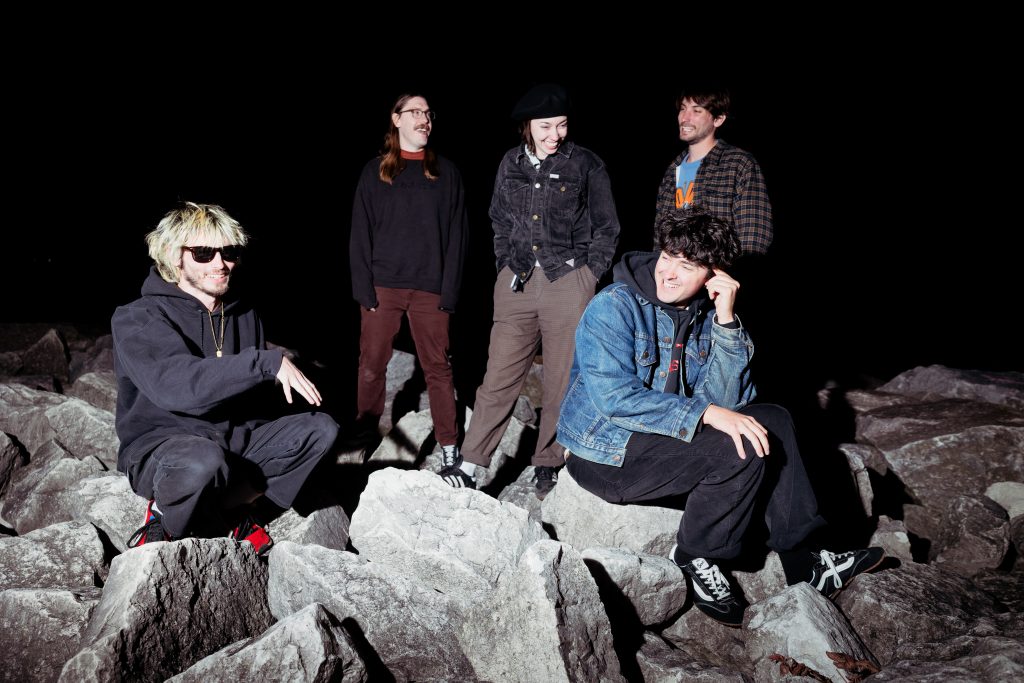
Front, left to right: Logan Bush, Carson Janke
Photo: Baldomero Plata
Let’s address the burning question (at least it’s something I always wonder about). The name Social Cinema doesn’t have a grand origin story. Griffin saw the name in an old newspaper. There were other names — Pleaser, No Witch, Sacred Objects — but the group voted, and Social Cinema stuck.
“Once you have a band name, it doesn’t really matter,” Crisler says. “Like, the Arctic Monkeys is such a stupid band name, but they’re the Arctic Monkeys. You get to a certain point, and it doesn’t matter.”
“You just make it make sense,” Griffin says.
That kind of nonchalance is a mask for something much deeper. It takes a lot of guts to dedicate time, energy, and money to something that isn’t ever guaranteed to pay off. To Griffin, success for Social Cinema would mean it can self-sustain and fund itself.
At least that’s the goal for now.
“There are stepping stones,” Crisler says. “You have goals when you start, and once you reach them, you have completely different goals.”
It’s a nihilistic feeling that you’ll never be completely satisfied. Once you accomplish a goal, another one has already taken its place.
“But, not in a bad way, because there’s always something [to achieve],” Griffin says. “So that’s kind of exciting.”
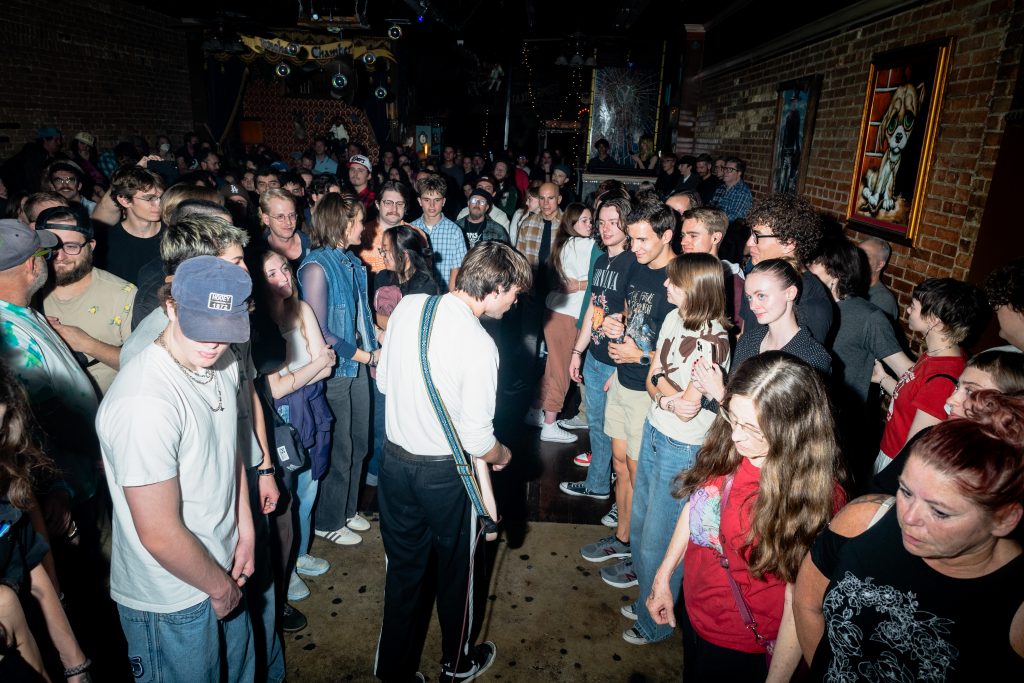
Photo: Baldomer Plata
Social Cinema was formed during the pandemic as a new project to foster the members’ creativity.
“We all came from different bands and just kind of started over,” Logan says. “[We] put out some self-released EPs in 2021 and 2022, then just started touring from there.”
Social Cinema released their debut album, “Don’t Get Lost,” in fall 2025, kicking off the tour and fueling content for the setlist.
“Don’t Get Lost” is a thoughtful, poppy release that seamlessly flows from one track to another. It feels like a cohesive journey through emotional clarity and atmospheric exploration. Across the tracklist, the band leans into a cinematic blend of indie-pop, electronic textures, and warm guitar.
But there’s something different about seeing a band live. It’s emotional; it’s the total experience. More senses are engaged; you hear the band, you see the band, you can feel the bass in your chest and the thrum in your eardrums, and you feel somehow connected.
Not the Life it Seems
Few of us average Midwesterners know what it means to be in a touring band. So, let me (as a woman) mansplain touring for bands playing small to mid-size venues.
The five members of Social Cinema travel with a photographer, and that’s it; they take turns driving a large van from one destination to the next, playing 100-200 capacity venues. It’s like what you might imagine: sleeping on couches and floors, eating gas station food, and surviving on little sleep and energy drinks. It’s definitely not the life of pop superstars in private jets or the rocker-and-groupie duos of the previous century.
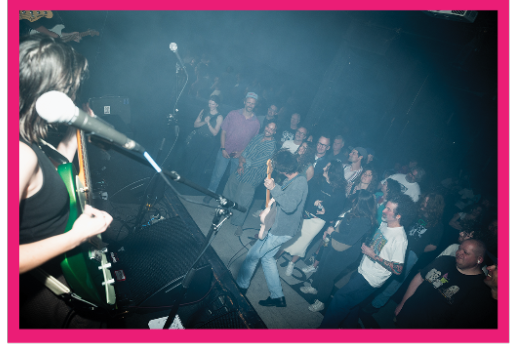
There isn’t any casual sex or crazy ragers. You can forget about the drug binges and throngs of people clinging to the illusion of popularity and fame.
“It’s kind of boring in that sense. It’s almost anti-glamorous at this level. We’re asking people if we can sleep on their floors and making $200 [a night] — and we love to do it,” Logan says. “We’re not a big party band… there’s just not much room for that kind of stuff if you want to be successful, in our opinion.”
You aren’t treated like a luxury and are often left to fend for yourself. In Milwaukee, Social Cinema and its touring partner Sego rented a loft for the night. Too many people crammed in one space usually means an odd man out. On that particular night, Logan was the one left without a bed. Each bandmate pays their dues, handing over their sleeping bag. Then, he trudges to the stage (it’s the only place not already occupied by a body) to sleep alone.
It happens enough that the band has named the occurrence ‘sleeping bag tower’ — I know I was expecting something a little more creative, too.
“That’s what I did on the stage,” Logan says. “I’m pretty used to it, I’m a floor sleeper by now, but I don’t really mind.”
And there are those little things you forget about, like laundry and showers. It’s not like the van is equipped with things like that. Most venues at this level of touring offer some home-like accommodations. But don’t get your hopes up, most times they aren’t afforded the same love and attention as hotels or a friend’s home. But you take what you can get.
“Sometimes it’s really nice, and sometimes it’s like ‘Oh God, I don’t want to step in there,’” Logan says.
The Joys and Lows of Midwest Traveling
Davenport, Iowa, was my second stop. It was drizzly outside, but inside the Raccoon Motel, it was beginning to fill up with people for the night. I couldn’t tell you what color the walls were because of the sheer amount of thrift-store junk lining them — taxidermy animals, antique advertisements, assorted frames, and random photos.
Crisler, Griffin, Janke, Chrastil, and I sat in a booth in the far corner of the bar, dimly lit with squeaky, black leather seats. There’s light conversation about the show the night before that I couldn’t attend, but mostly I’m drawn to the realities.
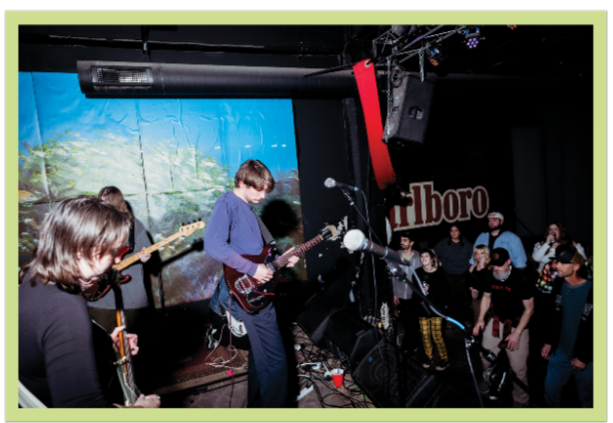
Photo: Baldomero Plata
All your basic needs seem to be a sacrifice, and normal functions are a little harder to complete. You find all your meals at the nearest gas station or wait for a fast-food joint to open up.
A woman interrupts us, as if on cue. She offers the band a black styrofoam takeout container filled with soggy-looking sweet potato fries — Griffin takes it into his hands, says thanks, and picks at them for the rest of the conversation. The woman the band had met only a few hours before — call it desperation, but maybe that bit is just Midwest nice.
But when you spend hours every day in a van with five other people, you take what you can get. Each member rotates who drives, though Griffin hasn’t driven for three years due to his inability to get going on time.
The Plains lack the scenery of coastal or mountainous regions; there’s rarely even trees, but even still, the hours on the road are peaceful.
“There’s always something to see, always something to look at,” Crisler says. “I like to look at the landscape even if it’s just cornfields and cows. I like it better than the interstate.”
It’s easy to get snippy if you’re in a car for too long or don’t get enough sleep; it’s human. So, you can imagine that tensions can run high. But most times, the fights are more or less critical on past shows like ‘Hey, you were playing too fast’ or ‘That was sloppy’ — not quite fighting.
“I feel like everyone hits at different points, but that’s why we do a really good job of making sure we go on hikes or making sure if we have time, we’re not just sitting in the hotel being grumpy,” Logan says. “We all trust each other to have the experience to work through it and keep going. It’s definitely not easy, but we all want to be out here. If it were easy, everyone would do it, everyone would be in a band.”
The compromises to diet, quality of sleep, and cleanliness are unavoidable (though I’m pleased to report that no one in the band smelled), but it doesn’t come without some perks. What touring lacks in care for your physical wellbeing, it makes up for in a sense of freedom.
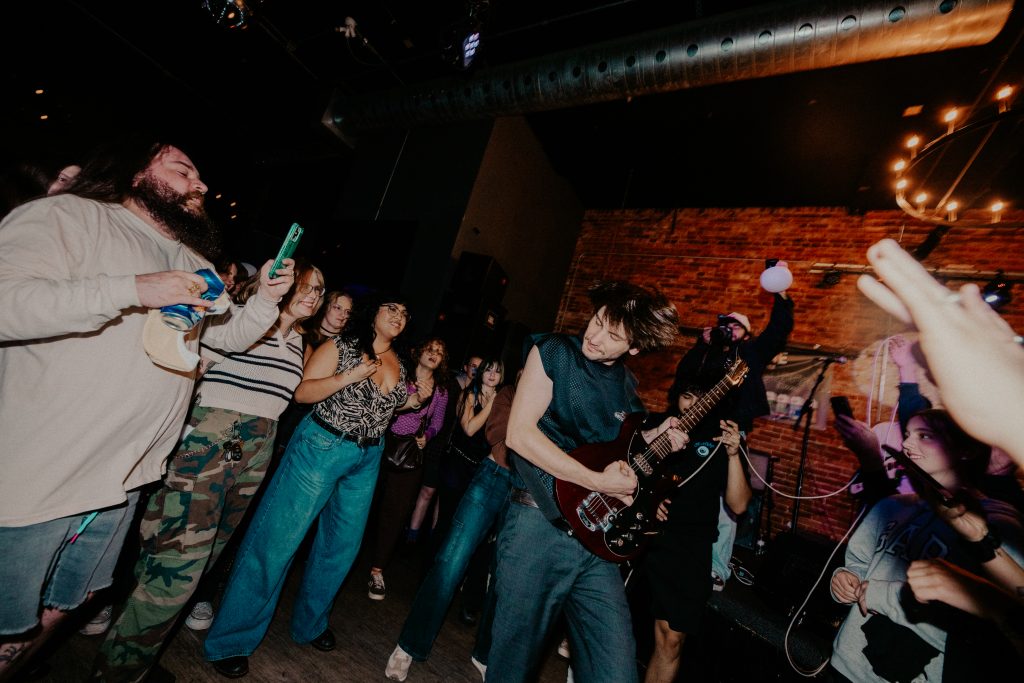
“I was actually thinking about that earlier on the tour. I was walking around Davenport, and I thought, ‘Damn, it’s kind of cool — I get to just walk around,’” Logan says. “It’s cool to be [in control and say] ‘Do we want to go to the East Coast?’ And then just do it.”
When you’re on tour, the main commitments you have are making it on time and playing a good show. Sometimes the trip allows for some free time, and Social Cinema has time to explore the areas they visit.
“It’s not fun to be trapped in one spot the whole time, for the whole day,” Griffin says. “We try to go to tall places to overlook certain areas, just to get a glance of the city.”
Hiking and exploring touristy locations are one of the ways Social Cinema unwinds after hours in a van or a hotel room. They also make time to check out record shops, thrift stores, and countless Barnes and Nobles.
“That was an old tour thing we used to do,” Logan says. “I would start reading a book, and then we’d go to the next city and a different Barnes and Noble, I would pick up where I left off — it’s like getting a free book.”
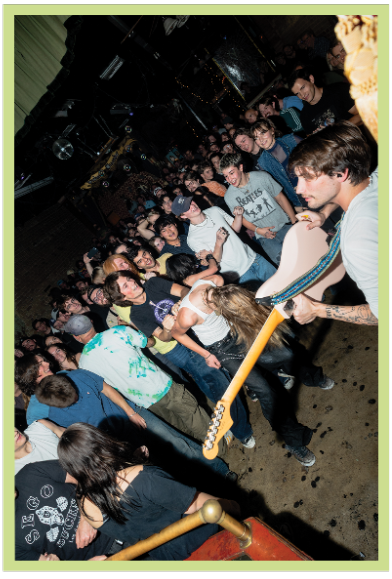
When you’re making little more than $200 a show, you can’t imagine five people can make a living off one tour. Everyone has day jobs. Crisler and Logan work freelance jobs, Griffin and Janke work at pizza places, and Chrastil scoops ice cream.
But they all tell their employers their first job is the band — that touring and playing take priority.
“When you add the gas, food, motels … it’s something like $8,000 to do this tour, and we’ll hopefully make $2,000,” Logan says. “For most bands, it’s really good to go out for three weeks and bring back a few grand … for the most part, we’ll just use it for the next tour. It’s gotten to the point where the band is paying for itself, which is nice because we’re not taking a personal hit financially.”
I know what you’re thinking. Young people wanting to pursue a band: What does their family have to say? Rock stars aren’t exactly what Nebraska or Kansas typically conjures up.
“I turned 27 on this tour, and I called my mom on my birthday … I [asked], ‘What did you think I was gonna be doing when I was 27?’” Crisler says. “She said, ‘I never saw you working a day job. I figured you’d be doing something to travel the world and doing music… I expected you to be exactly where you are,’ which is pretty sick.”
Crisler, Logan, and Griffin all share sentiments that their families are supportive of the band and their lifestyles. Griffin says his parents treat Crisler like a daughter, and she spends more time at their place than he does.
Romantic relationships don’t weaken on the road.
“My fiancée and I have been together since I was 19 — I’m 27 now. She is very supportive and always has been…” Logan says. “We all have partners and family at home, it’s half making sure you have balance and trying really hard [to put in effort] and half getting lucky with supportive partners [and family].”
In the Middle of Nowhere
The Midwest might not be the picture-perfect image for art, but that way of thinking is so dated and close-minded. Artistic qualities aren’t exclusive to the overembellished coasts.
“It’s important to bring art outside of New York and LA or the coast or whatever,” Crisler says. “That’s where people expect it to be from…you have to prove yourself more [than] in LA or New York, [because] a lot of bands [there] know people, so they get opportunities we could only dream of. But if we move to LA, we would be just another fish in the pond. I think it’s more important to us to mean something in our communities than to just be something.”
It’s true, if you’re in a band in the Midwest, you stick out a little more. It’s unexpected; it piques interest. The spotlight isn’t here, so you’re able to grow organically, and each musical project develops its own unique sound and image.
Also, with the capabilities of modern tech like TikTok and streaming, you can reach more people outside your small Midwestern town than before — even without touring.
“It feels like with the internet, you’re kind of everywhere at once, and it doesn’t really matter where you’re from,” Crisler says. “So, might as well live somewhere that’s cheap.”
Social Cinema is from the Midwest and is well acquainted with the area. But the band they are supporting on this tour, Sego, isn’t. Sego is out of Los Angeles, which is about as opposite from the Midwest scene as you can get.
“You know it’s funny because [the coasts and the Midwest] are more similar than you think,” says frontman Spencer Petersen. “It’s just in scale: bigger town, bigger art scene, smaller town, smaller art scene. I feel touring gives you a unique perspective in each little ecosystem, and you’d be surprised at how much people were talking about the same thing.”
It would be nice to hear that there is something that makes us cooler than the seemingly cooler coastal hubs, but that’s not quite right. It’s just different. When did it become that we are so defined by the physical landscape around us?
“There’s something about driving around the Midwest in a van, it gives a specific feeling that you’re in America. It’s the most American part of America to me,” Petersen says. “You’re just out in the sprawling terrain with hundreds of miles between cities. It feels like an adventure.”
On the Road Again
It’s the last goodbye. This time, Crisler, Griffin, Logan, and I stand around the merch table on the upper level of the Subterranean in Chicago. From here, they’re on their way to Nashville and eventually home.
It’s fascinating how bugging people for a week, seeking out three shows, and calling them during their long van rides can create a kinship. I’m sad to go, and I think the band feels the same. Crisler hugs me, and the rest share ideas of another tour and another story. We will see.
For now, it’s Social Cinema (and Baldomero Plata, their photographer) against the world.
“No matter where you go, people are gonna like music and want music to exist,” Griffin says. “It feels like there’s this overall obligation to me to give back to that and to allow it to keep existing. So, I’ll keep touring as long as people keep watching, because it’s fun to me and it’s fun to everybody else…That’s the most important part.”
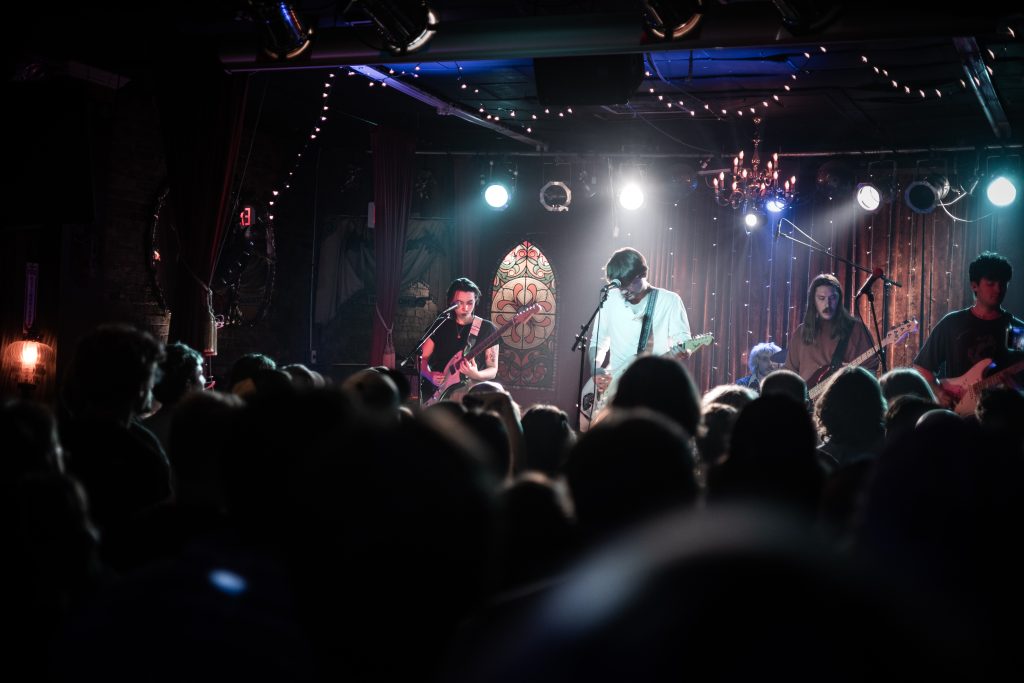
Photo: Baldomero Plata
As of now, the tour has ended, and Social Cinema has returned home for some much-needed rest and time with family. But it won’t be long until they set their sights on new tours and more goals. Next up is playing arenas, according to Crisler.
But home is where the heart is, and they will, of course, keep playing music for the Midwest locals in dumpy bars and small venues across the heartland.
2 responses to “The Midwest isn’t a Waiting Room; It’s the Main Event”
Outstanding article. You captured it perfectly.
This is fascinating and not at all what we all think goes on backstage. I have so much more respect for small bands now.