
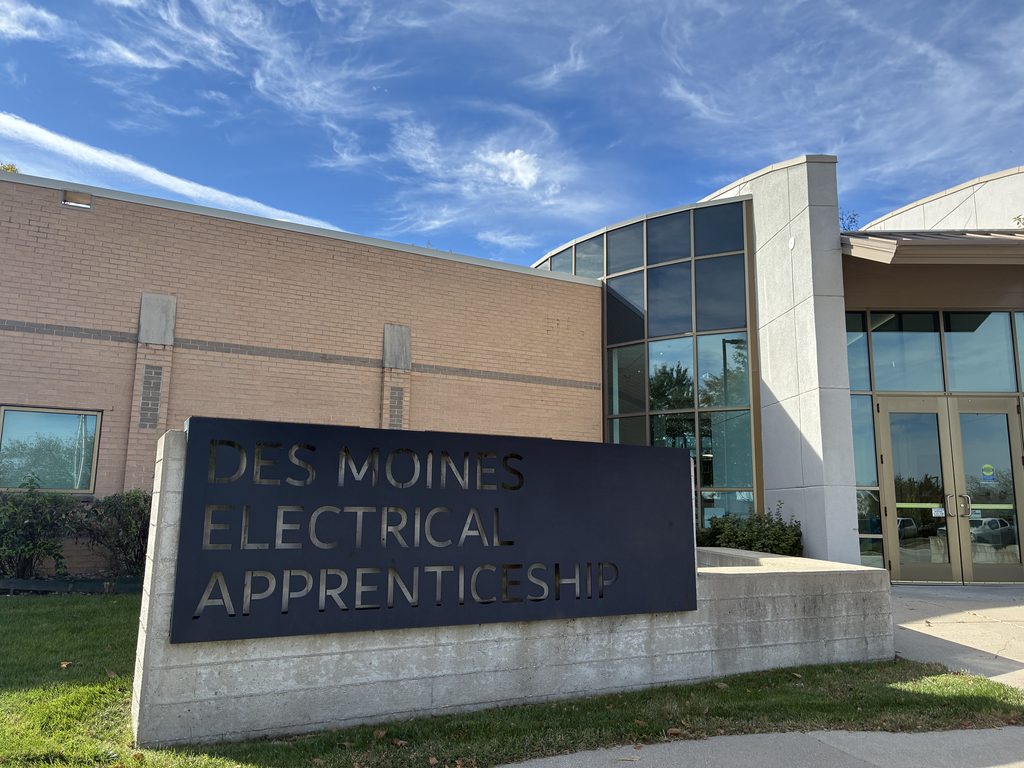
Outside of the Des Moines Electrical Apprenticeship building, where apprentices of IBEW Local 347 complete classes and labs.
Matt Resor has been an electrician in Iowa for nearly 25 years. When he started, data centers were not the main focus of the work, and certainly not like the massive AI computing centers we see popping up over corn and soybean fields. But in 2025, when Quality Technology Services announced a $10 billion data center project in Resor’s district, that changed quickly.
“You know, this feels like the next industrial revolution. And so we’re all just trying to adapt to whatever this economy is.”
– Matt Resor, IBEW Local 405
The data-center revolution is here, and it’s already quietly shaping blue-collar labor in the Midwest.
Keeping up with the revolution
Data-center construction is creating work across the skilled trades, particularly for electricians. Wiring power to servers, bending conduit and splicing cable are among the skills needed to build these sites, which helps explain why the International Brotherhood of Electrical Workers (IBEW) has already recruited 34,000 new members nationally in 2026. The union reports it hasn’t seen those kinds of enrollment numbers since 1969.
IBEW Local 494 in Milwaukee grew from 3,000 members at the beginning of the year to 3,900 members by September, according to Business Manager John Jacobs.
Despite the historic recruitment numbers, building a single hyperscale data center can take thousands of electricians — a demand that strains existing electrical unions’ labor pools.
But before data centers even entered the picture, the industry faced a significant challenge: its retiring workforce. Experienced journeymen — meaning long-time workers who have completed their apprenticeship and earned certification — are retiring in large numbers.
The National Center for Construction Education and Research estimates that 41% of the construction workforce will retire by 2031. And, according to Associated Builders and Contractors, one in five electricians is older than 55. It takes time to refill this labor pipeline, and right now, it’s shrinking faster than the industry can keep up.
Local union chapters in the Midwest were working to fill this gap long before data centers created the current boom. In fact, Jacobs says they’ve been looking at expanding apprenticeship class sizes for the past three or four years.
“The data center, I can tell you, certainly helped move the discussion along,” Jacobs says, referring to the new Vantage Lighthouse Campus in Port Washington, Wisconsin. “It just needed, I guess, that little extra push, and we got it.”
Union chapters are already adapting to increased demand through larger class sizes, but they still may not be able to keep pace with data-center construction.
Competing timelines
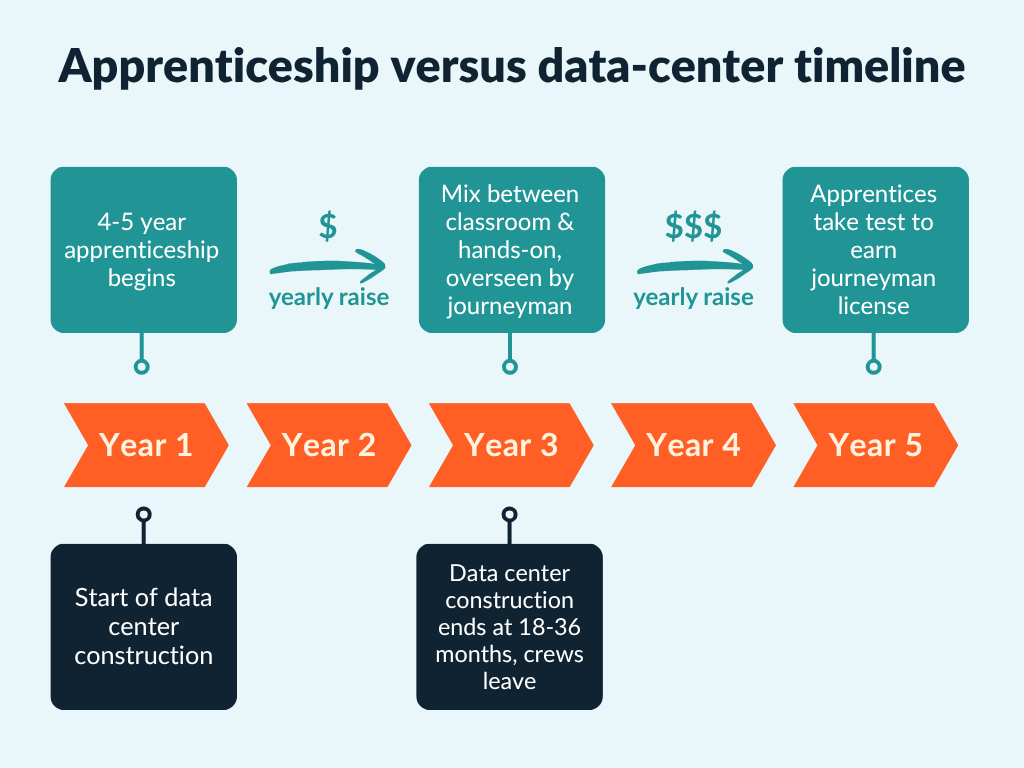
Even massive, hyperscale data centers have tight construction timelines and are usually completed and operational after only two to three years of building.
By contrast, an IBEW apprenticeship takes four to five years to complete depending on the local chapter.
The competing timelines of apprenticeship training and data-center construction leave new apprentices racing the clock — hoping the work that first drew them to the trade will still be there when they graduate.
Still, the market demands data centers, and a retiring workforce must be replaced. Take a deeper look at the time constraints facing blue-collar workers, and how the workforce is already adapting:
The four- to five-year wait
Apprenticeship timelines may vary by local union chapter. Joint Apprenticeship & Training Committees oversee training and establish each program’s curriculum, structure and length. A traditional electrical apprenticeship requires 8,000 hours of on-the-job experience and 900 hours of related classroom instruction over five years.
But with demand for electricians increasing, not every union is following that formula.
“We have shortened our apprenticeship to a four-year apprenticeship instead of a five to try to get apprentices turned out quicker,” says Resor, business manager of Local 405 in Cedar Rapids, Iowa.
Alongside Cedar Rapids, Local 288 in Waterloo, Iowa, Local 347 in Des Moines and Local 146 in Decatur, Illinois, are all using shortened programs. The 8,000 hours of on-the-job training are consistent, but classroom requirements have been reduced to 720 hours.
On-the-job training is a key component of an IBEW apprenticeship, according to Resor. “What we do is hands-on. It’s applied science … you’re not just learning something in the abstract.” Those 8,000 hours prepare apprentices to meet real-world standards when they graduate.
Still, there are concerns about shortening programs. “When you’re so used to a five-year [apprenticeship], you think, oh boy, if we go to a four-year, is the product that you turn out, is it going to be not as good?” Jacobs says. His local in Wisconsin has considered shortening its apprenticeship but is sticking with the traditional five-year structure for now. “It’s also one less year that you’re under the guidance of a journeyman wireman.”
Like the length, the day-to-day structure of apprenticeships varies, too. For example, some offer night and weekend classes while others require a consecutive week of class in between fieldwork. Some require students to pay for supplemental learning materials, while others operate at no cost to apprentices.
Training that travels
Regardless of a program’s structure, all IBEW curricula are guided by the Electrical Training Alliance, and apprenticeships are registered with the U.S. Department of Labor. Together, these organizations create national, standardized requirements for electrical apprentices. One requirement is the ETA aptitude test. It’s a timed exam covering algebra and reading comprehension that helps determine whether a prospective apprentice is accepted into a program, though retakes are possible.
Take a look at some sample aptitude test questions to get a better idea of an applicant’s experience:
Standardized requirements, such as the aptitude test and DOL registration, are important for electricians because they can ensure their training and credentials transfer across state lines, allowing them to follow work around the country. “Our training is nationwide,” says Stephen Coxe, the business manager for Local 347 in Des Moines, Iowa. “The curriculum that our apprentices learn here in Des Moines is the same curriculum that they’re learning in Oregon or Washington, D.C.”
Nonunion apprenticeships are also offered through trade associations such as Associated Builders and Contractors or Independent Electrical Contractors. Students can also pursue training through direct hire by private contractors, such as Baker Electric or Turner Construction. However, nonunion programs do not always have national DOL registration or use standardized curricula, meaning electricians’ certifications may not transfer across state lines. That creates a real dilemma when work dries up in a certain area.
Traveling workers are drawn to regions with active projects and high wages, which is part of the reason the Midwest has seen such an influx of electricians. “They’re actually paying money over scale,” Coxe says. He’s referring to Cedar Rapids, where some data-center contractors are now paying 15% to 20% higher wages than they were in 2022. “You’re seeing a lot of influx of traveling electricians, and tradespeople in general come into that jurisdiction.”
The two- to three-year clock
However, these traveling workers don’t always stay for the long haul. Sometimes, they come for a job and leave when it’s finished.
Construction of hyperscale data centers typically takes from 18 to 36 months, depending on a site’s size and planned output. For most careers, a three-year contract is not ideal job security (and that’s on the long end of projects). It’s also not enough time for an apprentice to complete their training. This poses a few issues. First, the Midwest faces a potential labor drain if and when data-center work slows. In the electrical field, this has happened before.
“I left the trade in 2013 because work had dried up,” says Quinten McMurry, a licensed journeyman electrician with Local 347. “Somewhere around 2008, 2009, half of our local wasn’t working, or they were working in other fields … Basically, they hadn’t taken a call, and that went on for a few years, or so.”
If work dries up in Midwestern regions, workers may leave in search of jobs, according to Coxe. That only applies to journeymen who have completed their apprenticeship and can actually travel, though. New apprentices entering the field during this data-center boom face a similar, potentially more serious issue: they may not have the long-term career security they expected when they first joined the trade.
Suppose a young worker begins an apprenticeship in 2026. Even on an accelerated four-year pathway, they would not become a licensed journeyman electrician until 2030. In the meantime, the four years that it takes to train and mentor an electrical apprentice is enough time to build a data center from start to finish. And because the boom is currently at its height, data-center work in the electrical field may be dwindling by 2030.
Lifespan of the boom
“You know, like any industry, when you start flooding the market with too much of something, it’ll eventually correct itself,” says Ryan Moffatt, the city of West Des Moines’ economic development director.
By the end of 2026, Goldman Sachs predicts global data-center occupancy rates (a measure of how much server space is in use) will reach 95%. That helps explain the market’s current demand for rapid construction. But as more data centers are built and more digital capacity becomes available, occupancy rates may naturally decline. Goldman Sachs expects occupancy to fall to 90% by 2031, with construction on new projects slowing soon after.
Although a slowdown isn’t expected in the near future, the Cement Institute also estimates that new data-center construction may slow by 2031, the same year apprentices entering the field now may finish their programs.
“Construction, and quite honestly any job if you think about it, if the demand falls off, someone’s gonna lose their job, unfortunately,” says Jacobs.
Without immediate demand for data centers post-graduation, new apprentices face an uncertain future. The good news is that labor unions are already preparing for a drop-off in data-center work; in fact, they have been adapting to the market’s needs for decades.
Preparing for the next revolution
“The blue-collar worker, whether it’s automation, outsourcing, whatever it is, we’ve had to adapt to the economy,” says Resor.
IBEW held its first union convention in 1891, when it was still known as the National Brotherhood of Electrical Workers, or NBEW. As a union, it has continually adapted to electrical and technological developments over time.
When nationwide broadcasting took off in the 1930s and 1940s, the union partnered with CBS to represent broadcast technicians and electrical engineers, an agreement that remains today. Then, as alternative energy gained traction in the 1960s, IBEW members worked on nuclear projects and plants. During recovery efforts after the Sept. 11, 2001, terrorist attacks, Local 3 members were among the first workers on Ground Zero, installing temporary lighting and restoring power to affected areas.
Now, they’re working at data centers.
“I didn’t realize when I was younger that we’re kind of a flexible workforce, that ebbs and flows,” says McMurry. He’s an example of how cyclical work affects blue-collar workers. After leaving the electrical field in 2013 due to a lack of work, data-center construction brought him back to full-time work as a journeyman in early 2021.
Risky business
Data centers are providing work right now, but that doesn’t guarantee future opportunities. The electrical field has always fluctuated, but with technology and AI advancing at a rapid pace, the future of the field — and its blue-collar workforce — is more uncertain than ever.
“I think the ones that really wanna be electricians will adapt to the market, to the field,” says McMurry. Data centers are changing the skilled trades market, as well as the blue-collar identity that comes with it.
If construction and electrical contractors stop developing, “it would put a lot of people and a lot of hardworking Iowans out of work,” Coxe says. That goes for electricians across the Midwest, and it’s a risk they must be willing to take.
Midwestern states also must be willing to take the risk of a temporary workforce. Electricians who put down roots in the region pay taxes, raise families and buy homes, all of which contribute to a state’s economy and livelihood, according to Moffatt. If workers leave in search of the “next electrical revolution,” their absence may be felt far beyond the jobsite.
So, next time you comment on Instagram or head to a local city council meeting, consider the nuance behind the building plans — the people actually building them — and what our region might look like if they disappear.