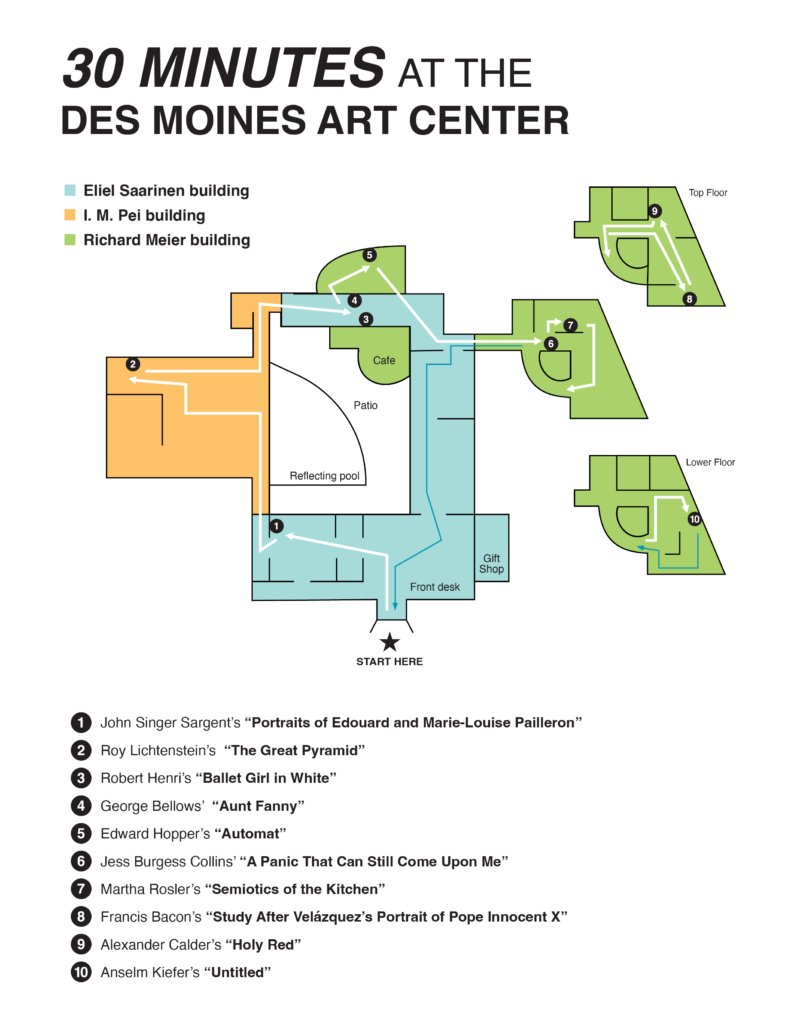
Hit the highlights of this one-of-a-kind Midwest museum.
Des Moines Art Center operating hours
Monday: Closed
Tue/Wed: 10 AM–4 PM
Thurs/Fri: 10 AM–7 PM
Sat/Sun: 10 AM–5 PM
The Des Moines Arts Center (4700 Grand Avenue) is a strong contender for the most unique art museum in the Midwest. The Art Institute of Chicago may have Monet’s “Waterlilies,” and the Atkins-Nelson has got the shuttlecock. But none of them is quite like this museum, which has both a storied architectural history and an extensive catalog of famous works — all found in the heart of Central Iowa.
The Art Center is not one building, but three: the work of architects Eliel Saarinen, I. M. Pei and Richard Meier form a patchwork museum. Inside those buildings is an equally impressive collection, including works by Andy Warhol, Henri Matisse, Jean-Michel Basquiat and Georgia O’Keeffe, among others.
Suffice to say, there’s enough intrigue for you to spend all day at the museum. But you don’t have to. With free admission, nothing stops you from dropping by the museum just to get 5 minutes’ worth of steps in.
And thus we meet our challenge: Say you want to check out the Art Center, but you’re an out-of-towner with a packed weekend, or even a Des Moines native who’s only got a lunch break to spare. How much of the Art Center can you see in only 30 minutes? What are the must-see pieces that are worth your precious time?
Follow this guide to make the most of those 30 minutes. It will take you clockwise through the building, hitting some of the Art Center’s most famous works (and a few of my personal favorites). Just remember to chug your coffee before you head in — no food or drink near the artwork.
00:00
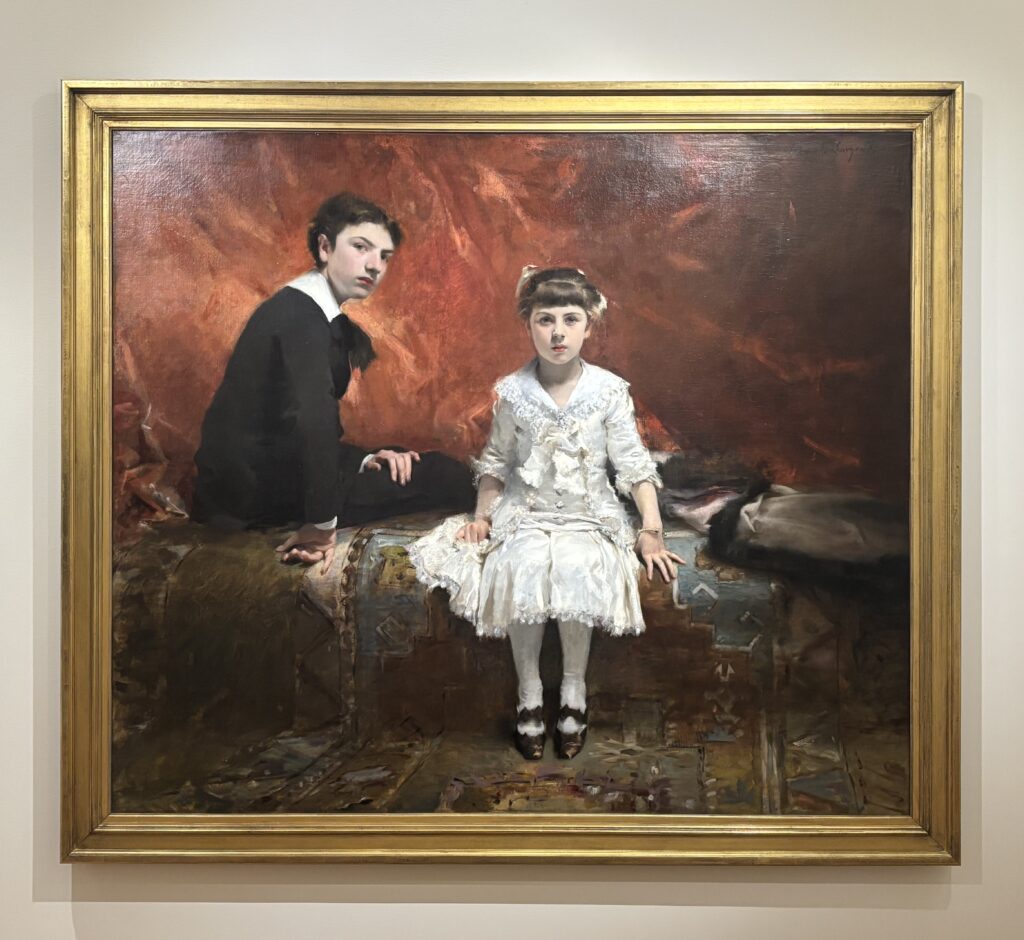
Photo: Stella Pihlstrom
Your first stop will be at John Singer Sargent’s “Portraits of Edouard and Marie-Louise Pailleron.” This oil painting may be one of the most striking pieces in the museum. The figures in Sargent’s work greet you coldly. The young girl, Marie-Louise, sits rigid as she stares blankly back at you. Her brother Edouard peers over his shoulder with pursed discontentment. The moody reddish-brown of the backdrop only adds to the stewing layer of tension. What the crux of that tension is remains unclear — take a seat on the bench placed in front of this painting and allow yourself to consider its source. Let yourself be taken in by the gazes of the Pailleron children. Pay special attention to the classic Sargent-style brushstrokes, which form a beautifully detailed image from afar and give way to an abstract and fluid expression of texture up close.
05:00
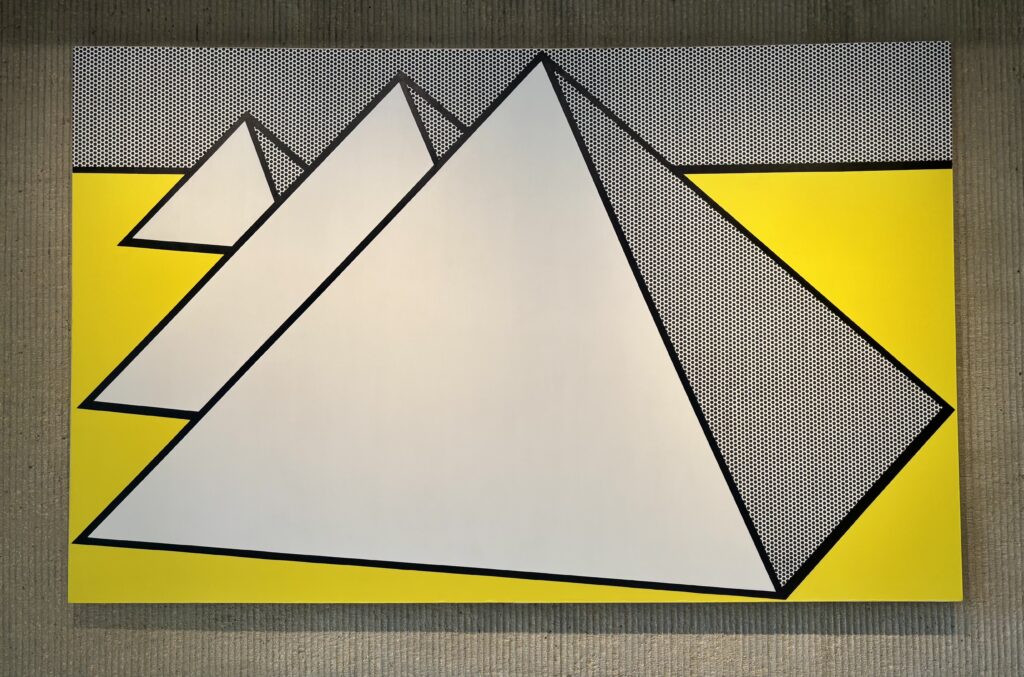
Photo: Stella Pihlstrom
Once you bid the Paillerons adieu, you’ll find your way to the I.M. Pei building with its so-called “butterfly roof,” with built-in skylights that hover over the room and allow sun to spill across the large concrete space. Wander over to Roy Lichtenstein’s almost 11-footall acrylic painting “The Great Pyramid” and prepare to crane your neck to properly take it in. Lichtenstein’s pop art rendition of the Great Pyramids of Giza depicts a wonder of the world in his signature “comic book” style. Flat swatches of bright yellow and thick lines of black are shaded by what’s known as “Ben Day dots.” This minimalist graphic style may seem simple at first. But when you stop to consider how long it must have taken to paint such a large piece with so much geometric precision, it’s easy to label the work as nothing short of a technical marvel.
10:00
Along the narrow hall of the Dahl Gallery within the Western leg of the Saarinen building, you’ll find Robert Henri’s “Ballet Girl in White” on one side, opposite George Bellows’ “Aunt Fanny.” Henri — known for painting societal outcasts — depicts his figure between performances, her face and figure untensed while still carrying the grace of a prima ballerina. For the time period, it was rather unusual to depict a performer not, well, performing. But that’s precisely what makes this piece so special. Her poised gaze is aimed at the wall ahead of her, on which hangs “Aunt Fanny.” Just like Henri’s ballerina, Bellows’ depiction of his real-life Aunt Fanny is posed firmly but calmly with her hands clasped at her front, exuding a kind of soft power. Imagine these two figures in conversation with one another: How do they relate to each other? What are the differences and similarities between the two pieces?
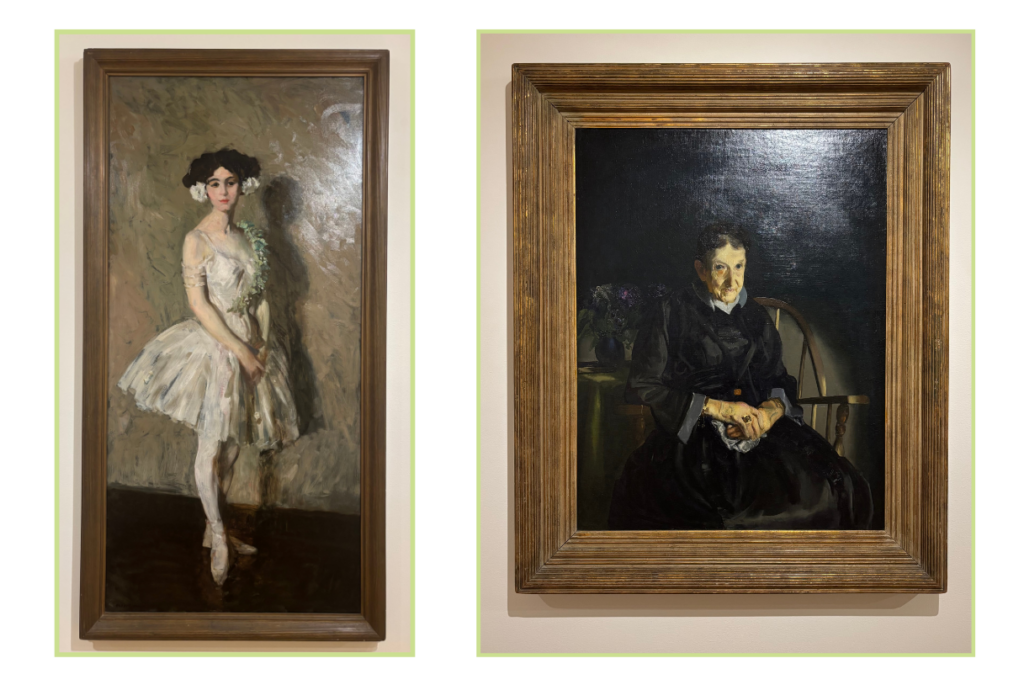
Right: “Aunt Fanny (Old Lady in Black),” George Bellows, 1920.
Photo: Stella Pihlstrom
15:00
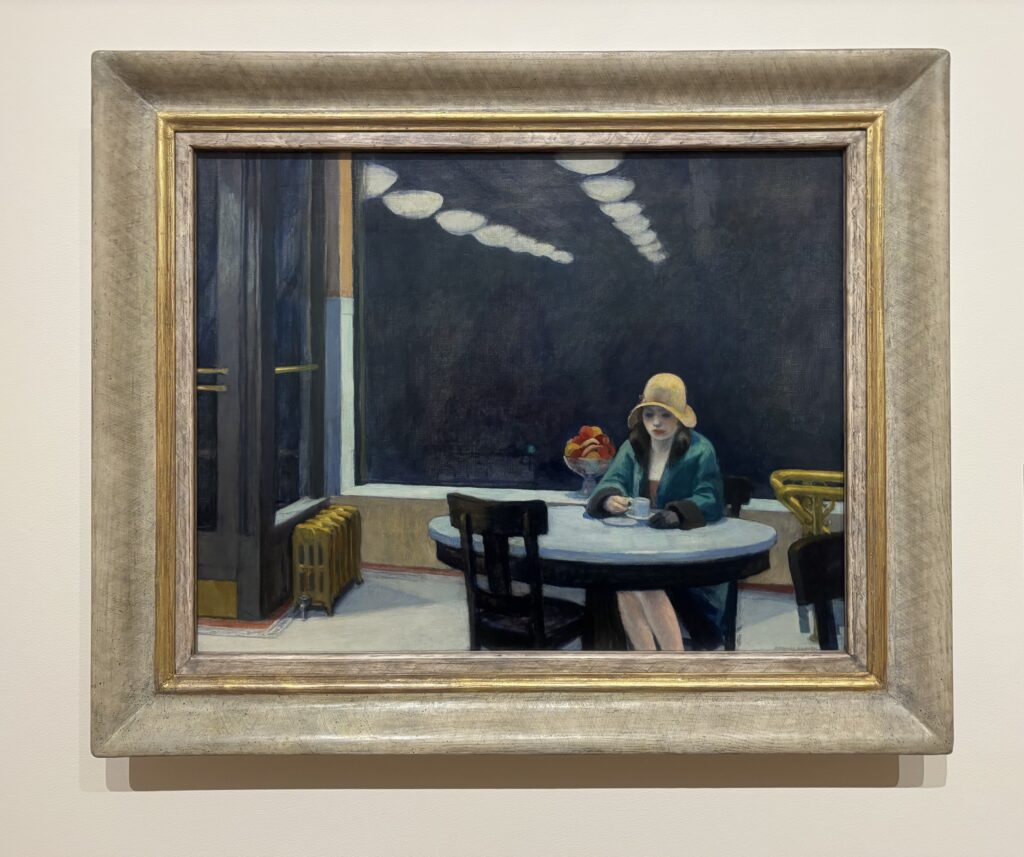
Photo: Stella Pihlstrom
In a room just off the Dahl Gallery lives one of the Meier extensions, on the North side of the building, which is filled with scenes from American life. If you must choose one painting to linger on in this room, head straight to Edward Hopper’s famous “Automat” painting. The woman in the painting sits by herself in an automat — a popular kind of restaurant between World War I and World War II, where you could insert coins to retrieve a ready meal from a small, glass cubicle. Scenes such as this were common at urban automats — patrons stealing a warm cup of coffee late at night, with tables reserved for women dining alone. Something about the lone figure makes it easy to invent your own story for the piece. Ask yourself: Who is she? Why is she there? How does she feel?
20:00
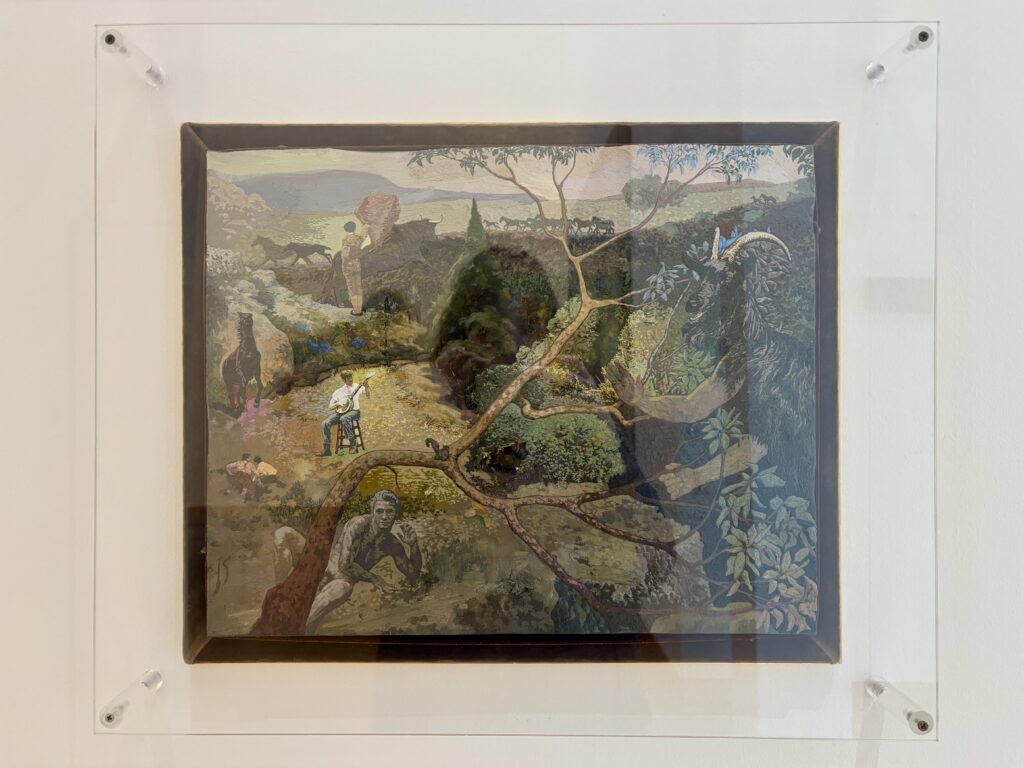
Photo: Stella Pihlstrom
You’ll have to traverse back through the Western wing of the Saarinen building to reach the second-floor level of the main Meier building. There, you’ll find two pieces, both rather peculiar in their own right. The first is small enough that you may miss it if you walk too fast. Jess (Burgess Collins)’s “A Panic That Can Still Come Upon Me” wasn’t created on plain canvas, but is actually layered atop an antique painting. This pseudo-collage work only grows more nightmarish the longer you look at it, with strange figures filling the scene. Prior to his art career, Jess worked on the Manhattan Project, which developed the atomic bomb during World War II. The story goes that he left his scientific career after having a vivid nightmare of the Earth’s apocalypse, brought on by the crushing power of nuclear weapons.
While still plenty strange, Martha Rosler’s “Semiotics of the Kitchen” is more likely to make you laugh. In this short film, Rosler dons the costume of a perfect housewife and sets the domestic scene of a kitchen ala Julia Child. But her delivery is monotone and brash as she takes you through the ABCs of kitchen utensils, miming the actions of each item along the way. Although there’s humor to her dry performance, feminist rage simmers just below the surface, accented by the violent way she stabs the knife and smashes the meat tenderizer.
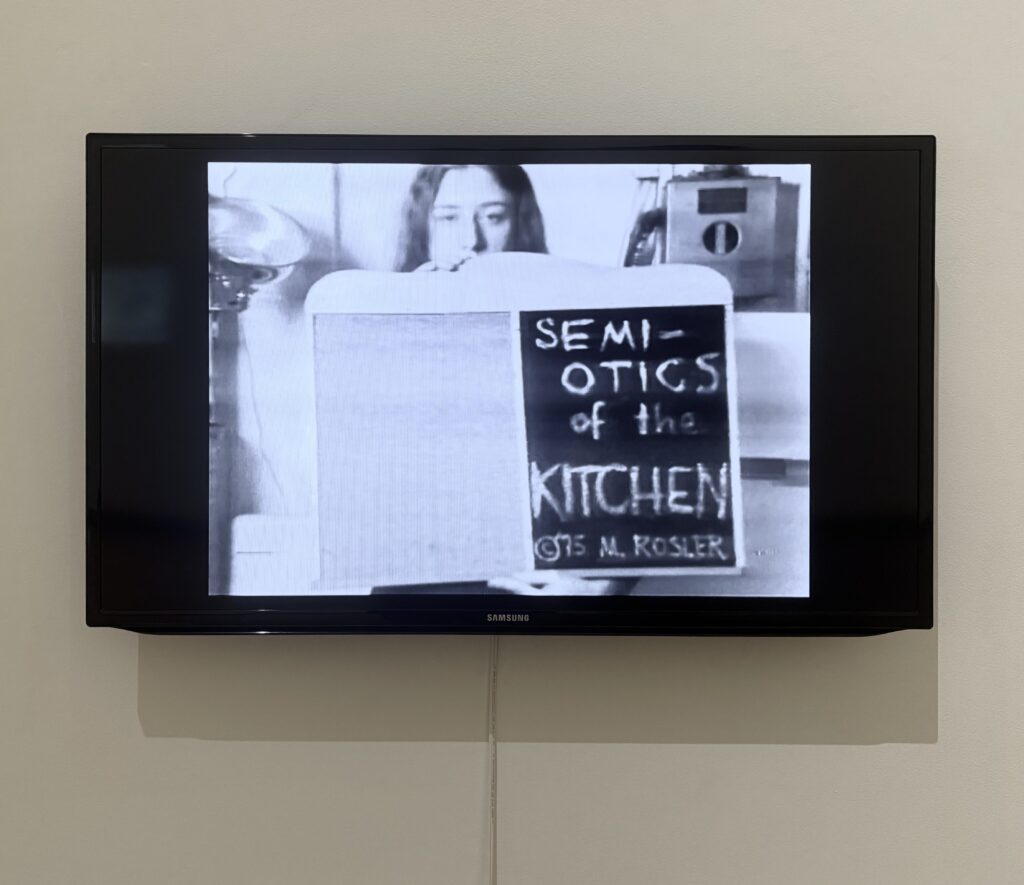
Photo: Stella Pihlstrom
25:00
Descend the curved stairs of the Meier building to find one of the Art Center’s most iconic pieces tucked towards the back of the third floor: Francis Bacon’s “Study After Velázquez’s Portrait of Pope Innocent X,” also known as the “Screaming Pope.” This eerie painting is one of many in a series of studies done by Bacon, who had become obsessed with Velázquez’s depiction of Pope Innocent. Bacon remade the work repeatedly over 20 years. He was supposedly fascinated by how Velázquez portrayed the Pope as simultaneously mighty and unguarded. This contradiction enraptured Bacon despite his atheism.
Back towards the staircase, just next to the windows and on a ledge that looks down on the second-floor gallery, hangs Alexander Calder’s “Holy Red.” Here, holiness lives in the work’s expertly crafted design. It’s no coincidence; Calder was classically trained as an engineer. Calder’s spinning mobile can offer your nervous system a calming respite after the shock of Bacon’s “Screaming Pope.” It’s that exact sense of tranquility that inspired the invention of baby mobiles, which were derived from Calder’s sculptures.
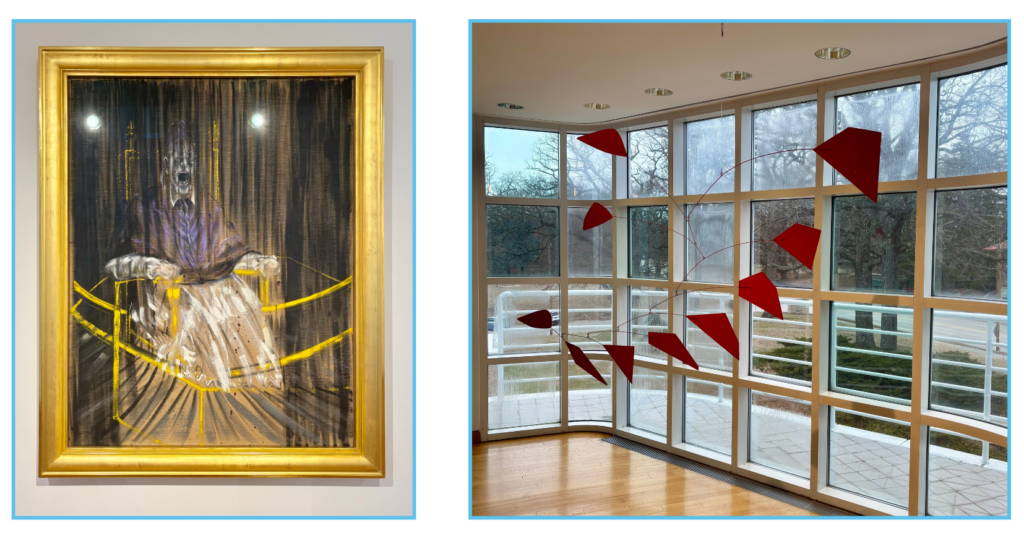
Right: “Holy Red,” Alexander Calder, 1960.
Photo: Stella Pihlstrom
30:00
As your journey comes to a close, venture down to the bottom floor of the Meier building to take Anselm Kiefer’s (unhelpfully titled) “Untitled.” Standing at almost 13 feet tall and over 18 feet wide, this is one of the few pieces that is up all year round; It hasn’t moved since its installation in 1988. This humongous, two-paneled piece is complex in its layered application, with lead, tar, hay, and dirt all caked atop the canvas. If you take a step back, you can likely make out the diverging lines of train tracks coming from the bottom of the painting. A battered ladder comes up off the canvas, a pair of torn-up ballet slippers dangling from it. The train tracks and shoes (both symbols associated with the Holocaust) are likely your first clue-in to this work’s implied subject. Kiefer has described the piece as his reaction to Germany’s attempts to rebuild post-World War II. This work grapples with an impossible question: How do we contend with the tragedies of the past? How do we ensure something so bad never happens again?
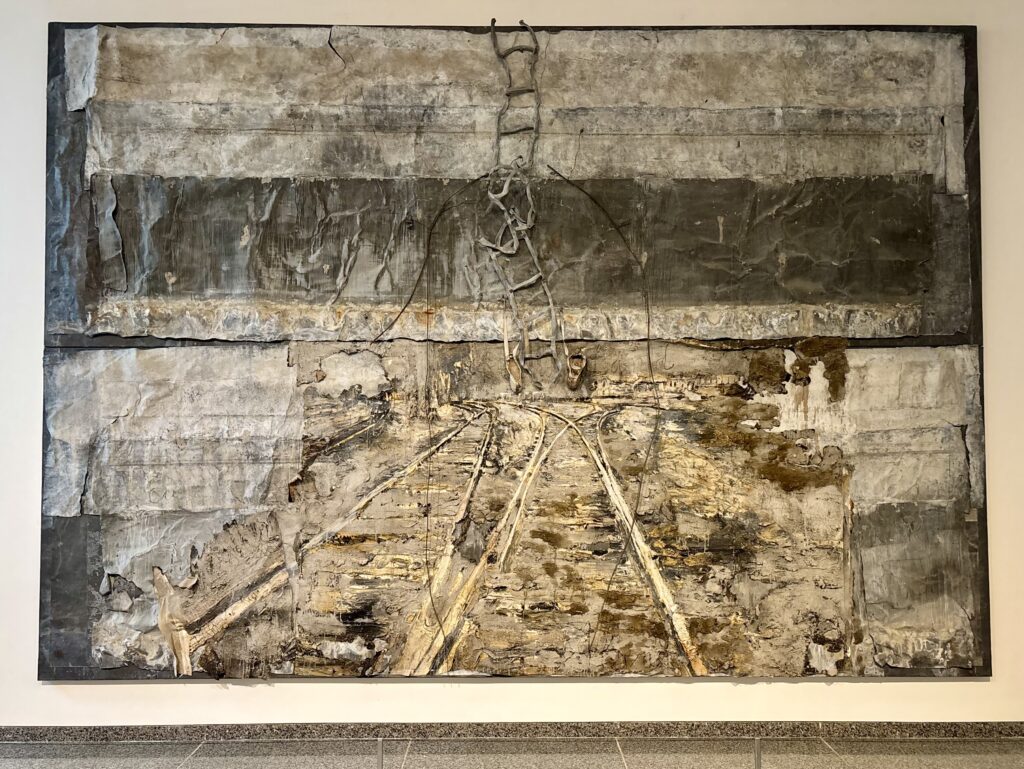
Photo: Stella Pihlstrom
Time’s Up
If you still have time to spare, there’s always more to see — linger in the galleries you visit. As you exit the Saarinen building, you’ll pass through an exhibition space which displays different collections on a rotating basis. Maria Lassnig’s “Honey, You’re a Wonderful Model” will be on display until May 17, 2026. On your way out, you can stop for lunch at the recently reopened Art Center Café for a quick bite or get some art-themed paraphernalia at the gift shop. When you’re ready, see yourself out. Remember that the Art Center will be there when you’re ready to return, no matter how much time you’ve got.
Here is your guide to 30 minutes at Des Moines Art Center