
Rural and urban areas are witnessing a surge in sex and labor trafficking, but these women are working to fight back.
This article discusses human trafficking, grooming, and subject matter that may be difficult for readers to digest. Please read cautiously, prioritize your well-being, and consider seeking support if needed.
Many imagine small towns, rolling plains, and neighborly attitudes when they picture the Midwest. Beneath this peaceful appearance flows a dark undercurrent – a hidden network where thousands of individuals are being exploited yearly. Behind closed doors of suburban homes, small motels, and high-end restaurants, sex trafficking operates in plain sight. This human trafficking crisis is fueled by connections made online, addiction, and poverty, which exacerbate an endless cycle.
Trafficking in Many Forms
According to the CDC, sex trafficking is a form of human trafficking that results in recruiting, harboring, transporting, and exploiting an individual to engage in commercial sex acts. Social media platforms are often used to locate and lure victims. Labor trafficking is another form of human trafficking that goes hand-in-hand with forced sexual acts. Traffickers attempt to lure vulnerable populations by promising safety or shelter, then forcing them to complete hours of work for no compensation.
Trafficking in Iowa
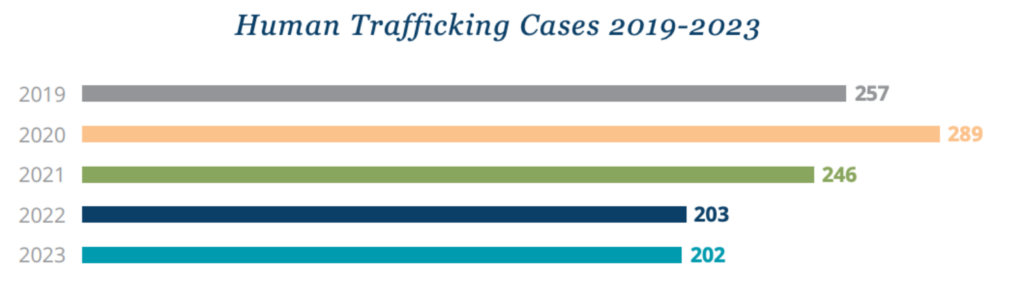
Iowa is ranked 13th in the U.S. for the most human trafficking over the last five years. An analysis conducted by Joslyn Law Firm, using U.S. Census data and confirmed human trafficking cases, highlights Iowa as having a high rate of trafficking. Between 2019 and 2023, the state reported 834 confirmed cases of human trafficking.
This translates to approximately 13 trafficking victims for every 50,000 residents. These findings shed light on the urgent need for continued efforts to combat human trafficking and support survivors.
Since its inception in 2007, the National Human Trafficking Hotline has received 2,208 calls in Iowa. 783 of these calls were identified as cases of human trafficking. The rest were made from individuals reporting a tip, requesting a referral, or reaching out for crisis services like temporary housing.
States with the highest number of trafficked victims include Nevada, Georgia, Mississippi, and Missouri. Compared to most other U.S. states, Iowa’s sex trafficking rate is significantly higher, but we see high rates of trafficking across the Midwest. For example, Illinois is ranked 40th, while Michigan is ranked 12th, and Nebraska is ranked 16th.
Why does Iowa have such a high rate of sex trafficking compared to other Midwestern states? In an interview with the Des Moines Register, Michael Ferjak of the Iowa attorney general’s office shares that Iowa’s law enforcement per capita is relatively low, and Interstates 35 and 80 present an easy way for traffickers to make victims disappear quickly. These main highways intersect in the heart of Des Moines, Iowa, creating a perfect storm in the Midwest.
“Truck stops have a large selling aspect happening there,” said Stephanie Olson, the founder and chief executive officer of the Set Me Free Project. “Truck stops are used as a marketplace, allowing traffickers to maximize profits by ‘selling’ victims to truckers, posing as massage businesses, and forcing victims to engage in commercial sex.”
Sex trafficking is heavily prevalent in Iowa, impacting the states that share its border, like Nebraska. In both of these states, there are a number of organizations seeking to end human trafficking across the Midwest.
The Set Me Free Project
One organization fighting trafficking is the Set Me Free Project, a non-profit organization based out of Omaha, Nebraska, that seeks to provide educational resources to school-aged children, adults, and businesses across the Midwest. Olson shared that the organization is motivated by a desire to teach individuals how to recognize the early warning signs of trafficking so it can be prevented.
“We started [the Set Me Free Project] because there were a lot of good things happening on the recovery side of human trafficking, but not on the prevention side,” Olson said.
The Set Me Free Project provides courses for hospitality. Businesses, like hotels, may directly encounter victims of human trafficking while they are being trafficked. Providing resources to these workers is an essential step in preventing trafficking around the Midwest.
The Set Me Free Project provides online and in-person training resources across the United States.
Recognizing the behaviors associated with human trafficking is not easy. There is no checklist of behaviors to look out for, making it difficult to spot human trafficking even among close family members and friends. While this is not a comprehensive list, the Set Me Free Project identified various warning signs that indicate an individual may be in danger.

“This could look like sudden changes in appearance or behavior,” Olson said.
She describes other major warning signs as hypervigilance against authorities, forming relationships with older individuals, hypersubmission – not looking people in the eye – and, most commonly, extreme exhaustion from long hours of forced labor.
The vast majority of individuals experiencing human trafficking know their trafficker and don’t self-identify as being victimized, Olson said.
Chains Interrupted
Teresa Davidson is the co-founder and chief executive officer of Chains Interrupted, an organization based in Cedar Rapids, Iowa, that focuses on educating high-risk youth on human trafficking in the state.
Davidson was inspired to start Chains Interrupted after learning about human trafficking on an international mission trip. She described her shock at learning about the prevalence of trafficking around the world, particularly in the United States.
“I just hadn’t been aware of it. I thought to myself, thank God I live in Iowa because [human trafficking] would probably be in New York or California,” Davidson said. “It’s everywhere.”
While working at a hospital as an Anti-Human Trafficking Coordinator, Davidson began growing Chains Interrupted into a full-time operation. Founded on three pillars, this non-profit educates youth about awareness, prevention, and advocacy.
“We provide education that not only talks about human trafficking but what to do if someone approaches with nefarious intent, self-worth, what a healthy relationship looks like … what a safe adult looks like,” Davidson said.
Chains Interrupted focuses on educational and advocacy efforts in high-risk neighborhoods. The National Child Traumatic Stress Network considers youth who are homeless, LGBTQ+, experiencing poverty, or experiencing an intellectual disability to be at high risk.
Chains Interrupted utilizes staff and volunteers to present at schools, host fundraising events, and engage in community outreach. Each task is critical to the non-profit’s operation, but speaking with survivors is among the most challenging. Davidson is responsible for responding to calls from school counselors, foster parents, and survivors of human trafficking.
“In the last five years, I’ve worked with over 300 survivors,” Davidson said. “On average, I work with at least one new person each week.”
How can Midwesterners make a difference in the fight against human trafficking? Davidson encourages everyone to take a closer look at their circle — at school, work, and religious organizations — and reach out to individuals who are vulnerable or struggling.
“That’s who they are after, vulnerable people,” Davidson said. “If we reach out first, the traffickers have less of a chance. That is the biggest prevention of all.”