
Exploring the evolution of Indian food in the U.S. through a dhaba.
This article includes an optional audio read-aloud for easier accessibility.
The majority of immigrants in the United States live in 12 metropolitan areas, none of which are in Iowa. But on the side of I-80 near Grinnell, Iowa — miles from skyscrapers or bright lights — two childhood friends from India have found a home for themselves and their food.
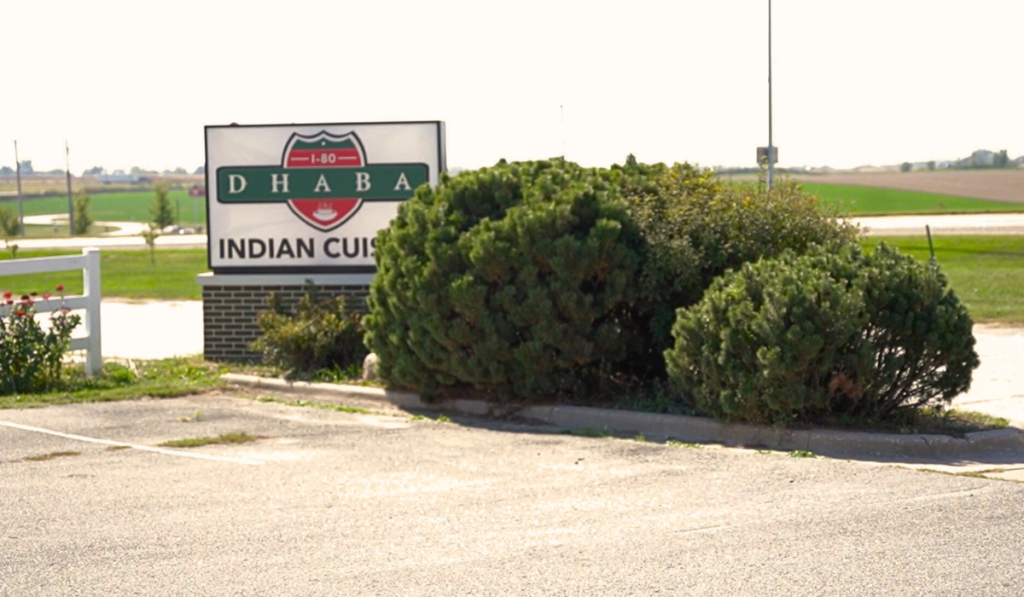
Photo Keila Perez-Serrano
From Oxen to Interstates
For 25 years, Ashok Kumar and Jasminder Singh have worked together in the restaurant industry on and off, work that took them across the globe. This year, they started together at I-80 Dhaba.
“[The name] is so that people can remember the location,” Singh says. The restaurant is not only beside I-80 in Iowa, but drivers must access it through exit 180.
The name also reflects the purpose: feeding travelers. A dhaba in India is a roadside restaurant that often serves truck drivers, though dhabas date back to the time of oxen and wagons. These casual eateries dotted the roads in South Asia’s Mughal era in the 1500s, when soldiers would have to traverse long distances across the empire. A soldier could lay down his arms and stop for a quick bite in a dhaba in the same way a 21st-century traveler might pull off I-80 for some samosas (potato-stuffed turnovers).
But dhabas across the pond are often made of metal or have outdoor seating, which wouldn’t work in Central Iowa, a region known for its tornadoes.
There are a few structural differences and thousands of miles between dhabas in India and the one, but the core is the same — reach audiences traveling and make them feel like they’re at home. Singh says that because his home state was small and on a plain, the area surrounding his restaurant feels similar.
“It’s the country, so we don’t feel like we are at our place [I-80 Dhaba]; we feel like it’s our hometown,” Singh says.
Indian food in the U.S. goes back to when colonists first arrived, even before these states were united. Through the English merchants they’d later revolt against, colonists imported faraway items such as curry powder and tea. Those tea imports would inspire the Tea Act — a tax that would lead powder-wigged patriots dreaming of independence to tip the drink into the harbor.
But the American interest in Indian food didn’t fall into the water with the leaves. In New England, tavern-goers slurped up curries in the early 1800s. “The Virginia Housewife,” one of the earliest cookbooks published after the Revolution (making it one of the first “American” cookbooks) described how to make chicken curry “after the East Indian manner,” though the author only recommended adding two spices (salt and curry powder) along with the solid ingredients — proving not only an American fascination with the cuisine but a weakness for spice.
Authenticity would come later, as people from India, including students, came to the U.S. in small numbers, and this number increased in the second half of the 1900s. With many cooking or craving food from home, the availability of Indian food grew. Today, the Indian food industry has accounted for $4.9 billion of the U.S. food market over the past five years.
From Childhood Friends to Business Partners
Singh immigrated to the U.S. at the turn of the new millennium, in 2000. He first lived in Chicago and then in Cedar Rapids, Iowa, where he had friends. He originally moved for “a better future,” which he believes he found in the “nice people” he met, he says.
Kumar first moved to California, then spent a few years in Jackson, Mississippi, before finally relocating to Grinnell, Iowa.
“While I lived in India, the small village, Grinnell — [it’s the] same [in a] sense. That’s the feel here,” Kumar says.
It’s often the region that determines cuisine anywhere, and that’s true in a country as vast as India, too. With mountains looming in the north and along the coasts around the country, Indian food varies by region, and that variety still stood when it was brought to the U.S. While many of the cuisine’s staples, such as potatoes, tomatoes, and peppers, are grown in the U.S., many aspects of Indian American cuisine are unique, including the I-80 Dhaba dal — a soup of pulses (seed-bearing pods such as lentils or beans) — that exists only at the restaurant.
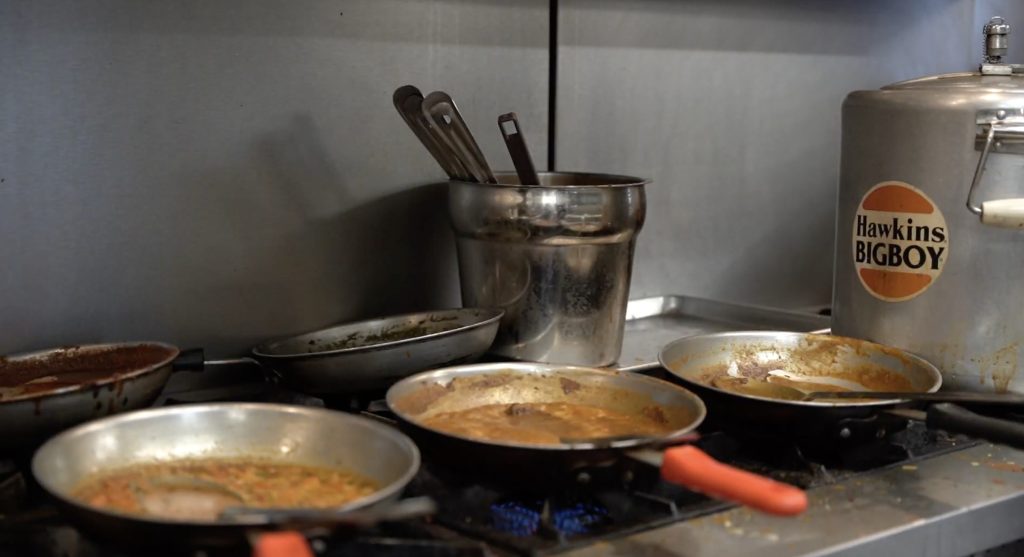
Photo Keila Perez-Serrano
I-80 Dhaba also serves many well-known North Indian dishes, including biryani (a rice dish) and paneer-based meals. While many Indian dishes are by nature vegetarian due to cultural practices, I-80 Dhaba also serves Beyond Meat, a plant-based substitute, for those who may want the flavor of meat without the animal parts.
The business of crafting and creating meals, which Singh entered because it paid well, is hard work, between planning and actually cooking. A key factor, he says, is “good company.”
“[It’s about] people who enjoy what they’re doing. So, it’s kind of fun — you talk to each other, you make fun, you work. It’s teamwork,” Singh says. “Individuals can’t do that.”
When a friend offered them the business last year so he could be closer to family, the two accepted. The understanding between him and Kumar, Singh says, is how the two run the business together. When one is working, the other is able to take off.
“We argue a lot, and it happens between friends, but our mutual understanding is ready, that’s why we choose each other to work here,” Singh says.
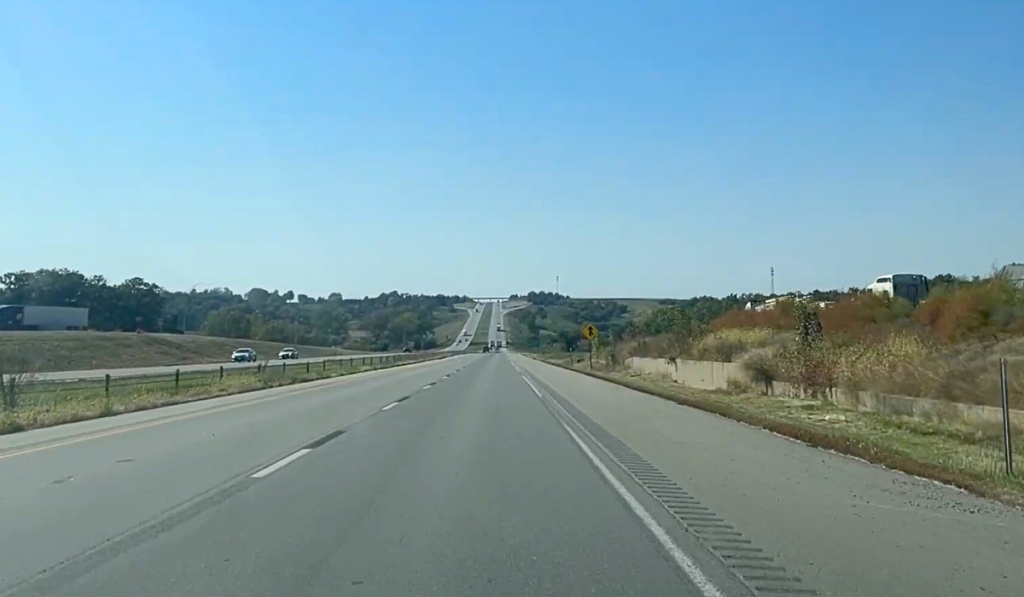
Photo: Keila Perez-Serrano
Finding a Community in Grinnell
“I surveyed my area, and first, when I came here, I didn’t see any local people here, any communities. So, then I tried Google Maps,” Singh says. “And then I found there was a small city, Grinnell.”
Only the sound of cars roaring down the highway interrupts the solitude of the restaurant. The skyline seems to stretch for miles. Grinnell’s nickname — “jewel of the prairie” — unfolds on the way into town. It’s the prairie part that dominates on the drive.
Inside, small floating shelves with figurines, an elephant and a bicycle among them, line the walls. Customers line up before the menu or pick up an order from an online ordering service. A whiteboard announces the day’s specials, which, when I visited, were leavened Peshawari naan (cashew, raisin, cherry, cranberry, and coconut stuffed bread) and cut mirchi bhaji (fried jalapenos served in chutney). A fridge offers drinks like mango lassi, a mango-based yogurt drink.

Photo: Keila Perez-Serrano
Inside the kitchen, naan (a flatbread) rotates in the oven and is flipped after being coated in butter. A large pot of chopped onions simmers, flavored with sprigs and spices. Various brightly-colored curries bubble in pans, stirred occasionally, ready to be poured into a bowl or over rice.
“It’s peaceful, really,” Singh says about the town and its residents. At a not-so-typical mealtime, 2:30 p.m., a family and a few lone travelers sat in their respective seats, separate yet sharing the same experience.
A town of 10,000 might not seem like the ideal place to open a new restaurant, but Singh and Kumar say they’ve found a good mix of customers, including college students and truck drivers — just like a dhaba in India.
“I was a little bit scared when I came here that there wouldn’t be many customers, but after opening this restaurant, they came,” Singh says.
I-80 Dhaba, he says, is the only place where travelers going from coast to coast on the 2,900-mile stretch of tar can get authentic curries or lassis in the next 40 miles, until they reach Iowa’s capital city of Des Moines to the west.
So, Singh says, “There is no competition.”
Looking Towards the Future
Since the sailing of the Mayflower, people have moved to the U.S. from around the globe, and today immigrants make up 5.6% of Iowa’s population. But for the first time in the past five decades, fewer people are moving than usual. This decrease may stem from policy changes such as increased deportations or visa restrictions.
What does it mean if fewer people are able to come to the U.S. seeking the better life that Singh did — if there are barriers to those moves? If there is one less dhaba that opens in the next decade? For existing diasporas — spread-out communities of immigrants — it means there will be one less way to connect with their roots. And for people in the U.S., it is one less way to connect, to meet people, try something new, and learn more about the global community we share.
The future of other U.S. dhabas may be unclear, but for their restaurant’s future, Singh and Kumar are looking at selling groceries in front of the restaurant soon, including Indian products that customers may not be able to get in other stores. An expansion of sorts.
The store gets all kinds of reviews, Singh says, despite averaging 4.5 stars on Google Reviews.
“I always say to my customers, if they don’t like the food, they can give us [back the] food, and we will try to give our best, and we apologize if we make anything bad or people don’t like [the food],” Singh says. “So, we try to do our best.”
“At least, in this case, it’s not all about making money. If customers are satisfied, then we are happy.”