
A group of Iowa hearse collectors is politely redefining what it means to die in the Midwest.
This article includes an optional audio read-aloud for easier accessibility.
When a line of $200,000 Porsches is on display, people pay attention — unless there’s a hearse parked across the street.
It was the 7th of September, at an annual showcase of vintage motor vehicles called the Concours d’Elegance (French for “competition of elegance”) when a group of Iowa’s finest hearse collectors rolled in.
That day, the Graveyard Ghouls Hearse Club, led by Kyle Rice, stopped every passerby dead in their tracks. Even mid-jog, a runner paused, his dog sniffing out the human skulls on Rice’s display table and knocking them over with his nose. People took photos. Some called family members to tell them about what they had just seen. Death paraphernalia on Grand Avenue in downtown Des Moines? This was something new.
Rice founded the club in 2023, looking for a community of hearse collectors. Little did he know other Midwesterners shared this fringe interest of his — 27,000 of them.
Odds and Ends
Barbara Mentzer is one of those thousands. After work as an operations manager at Microsoft, she serves meals to kids at her church in Des Moines, Iowa. Her voice carries a sweet bit of raspiness that makes you feel like you’ve known her for years — the kind of person who’d invite you to Thanksgiving dinner if you had nowhere else to go.
But like Rice, she also collects oddities and misses the time when death wasn’t such a skeleton in the closet. Mentzer first heard of Rice from a coworker. She soon joined the club, where she learned that a hearse isn’t a symbol of loss to these Midwesterners. It means connection. Traditionally the group gathers during October for trunk-or-treats, where children go from car to car (or hearse to hearse) for candy rather than house to house. This season the club is expanding — showing the hearses at the Gabriel House Fall Art and Music Festival and a haunted car wash. Spookiest of all, Slaughterhouse DSM, a Des Moines-area Halloween attraction, put a hearse ride up for raffle. Two winners rode in the back of Rice’s hearse, lying in a casket, for dinner with Mentzer and Rice at a local Des Moines diner fittingly called Zombie Burger.
It was only a few years ago when Mentzer told her husband she wanted a hearse. The family has long been car collectors, but what she didn’t know was that after all these years together he had secretly wanted a hearse too. They found theirs at an estate sale — a 1997 Cadillac bought for $1,000. Mentzer says that’s a bargain by any account.
By the time Mentzer got the keys from the previous owner, a farmer in central Iowa, the hearse had lived many lives. After the farmer’s wife died — she was the one who loved having the hearse around — he put it up for auction. Before then, it served as a sort of farmhand, and the farmer, whose desire for practicality is admirably Midwestern, “would drive it to Lowe’s and load the back with two-by-fours and drive it back to the farm,” Mentzer says. “No wonder the suspension was shot.”
So after its life of hauling dead bodies (and lumber), Mentzer resurrected the vehicle, “basically a station wagon,” as she calls it. These days, it spends weekends with her at car shows like the Concours d’Elegance or sometimes just to pick up groceries at Hy-Vee. Like Rice, she’s always delighted when her hearse gets more attention than muscle cars.
To her, though, the ghastly spectacle isn’t about dying; it’s about living. She says that if driving her hearse around Des Moines helps one couple feel comfortable having a conversation about death — arranging funeral plans or planning their wills — then it’s worth it.
“Everyone’s scared of it, which I get,” Mentzer says. “The older you get, the more you see that clock ticking and think of all the possibilities.”
Let’s face it. Mentzer’s right: death is terrifying. There’s no way to make it “Midwest nice.” But for the club, celebrating our collective mortality feels like a kindness.
The Number That’s Reserved for the Undertakers
When Rice registered his hearse at the DMV, the employee slid a license plate under the plexiglass divider, making him squint. The plate read “666.” It was almost too perfect.
The woman at the DMV explained that most people refuse a license plate with these satanic numbers, and it gets thrown into a kind of reject pile. But Rice says that some collectors even stockpile them, though his own custom plate reads: “HE DEAD.”
A hearse begins its life as a regular sedan, Rice says, and is retrofitted by a coachbuilder company such as Miller-Meteor to add enough space to carry a casket. Because hearses are manufactured in this way, they almost have the same fragile quality as the dead they carry.
“If something happens to this windshield, I can’t get it replaced,” Rice says.
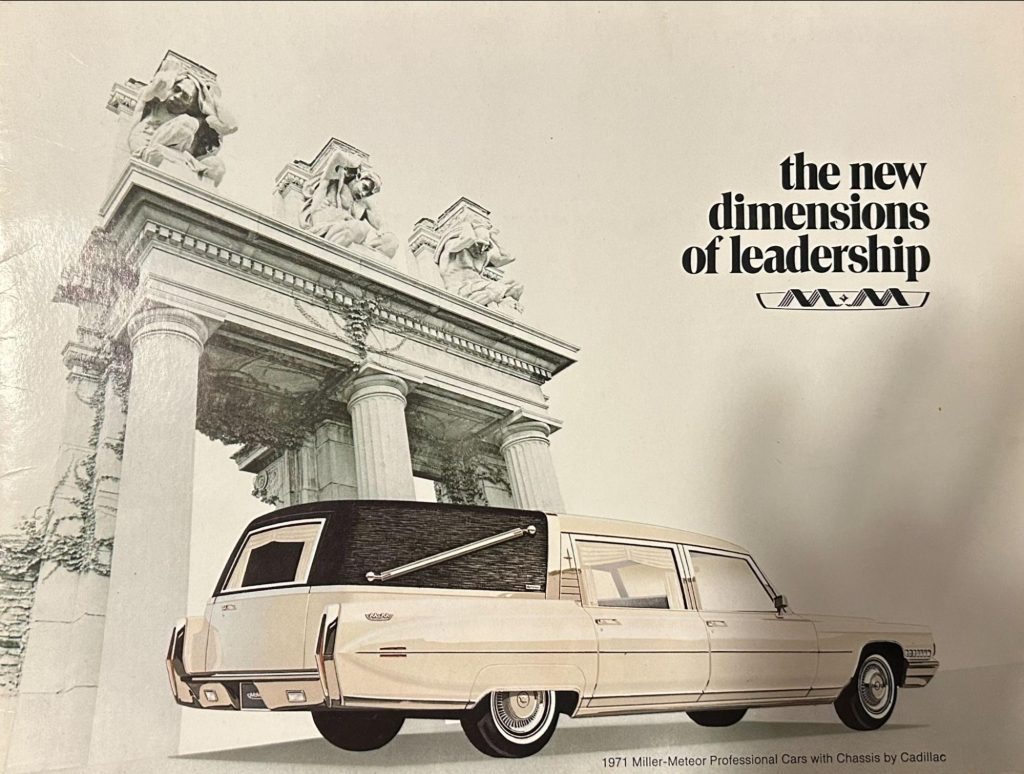
Photo: Rachel Kohl
On the club’s Facebook page, the community posts memorabilia constantly, meaning new antiquities are always up for grabs. Rice loves his hearse, but he dreams of an older time. Even in this space, value is attached to rarity and antiquity, much like in other car-collecting communities.
“I would die for that hearse,” Rice says of a milky-cream 1971 Cadillac, gesturing toward the front of a catalog a funeral director once gave him. The search for something more unique never ends — a new item brings a sense of pride but also a piece of knowledge to share with his community.
Rice suspects death fascinates everyone; they’re just afraid to look too closely. But even he can’t put his finger on why he’s drawn to it — it just feels natural.
Making Peace with Death, the Midwest Way
Some time after the car show, with hundreds of unanswered questions and a growing obsession, I found myself in Rice’s basement. I quickly discovered he’s more than just a hearse collector who works the graveyard shift.
I sank into Rice’s deep-set, espresso-colored couch, the same one that sits in almost every Midwestern basement, and set my audio recorder on the strangest-looking coffee table I had ever seen. The table was about as long as the tallest Midwestern man you could find, and just wide enough to set down a big ol’ casserole dish.
Except this table is not for food or coffee — it’s for a dead person.
Rice says the embalming table folds upward on both sides to elevate the person’s head and feet. But he says its expandability makes it perfect for party occasions — so sensible. These unusual objects (Rice prefers the term “oddities”) often find their way to Facebook Marketplace when funeral directors close shop.
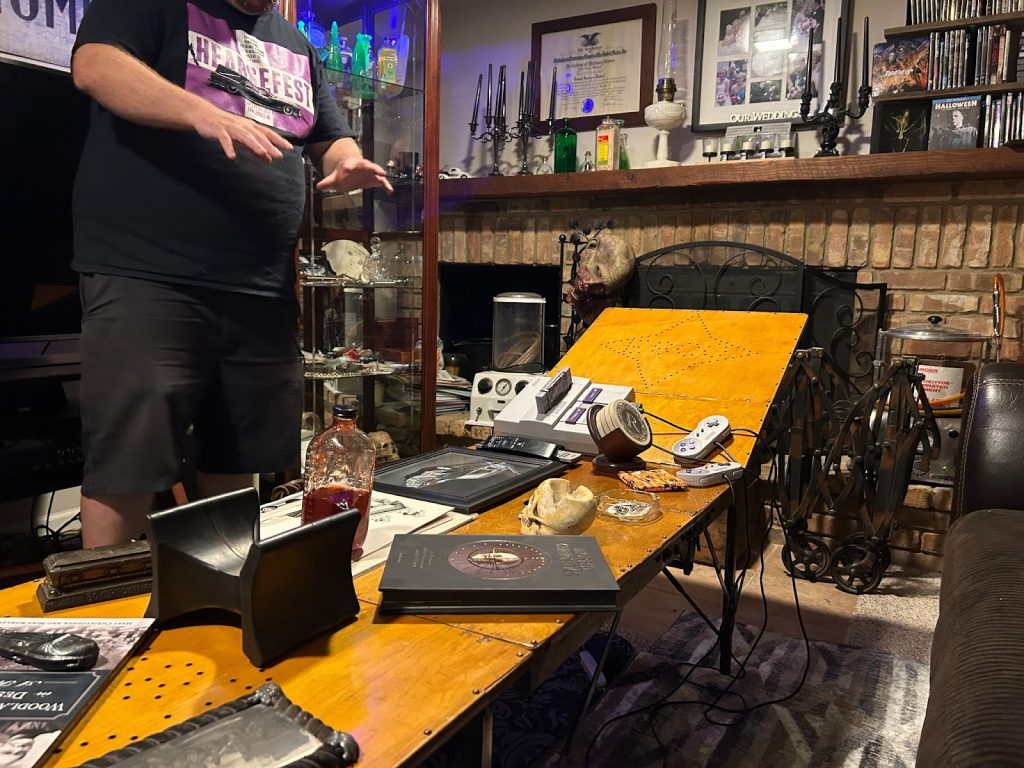
Photo: Rachel Kohl
Rice has made bids on felt caskets, wicker Victorian-era wheelchairs, embalming kits, and enough neon green-glowing candelabras to shock a radium girl. The assortment is so vast, his single-room basement looks like a page out of the children’s book “I Spy,” but in Rice’s version, “I spy a red clothespin clamp” turns to “I spy a real human skull.” Rice got his hands on that skull after Matt Lampy, a tattoo artist from Minneapolis, bought an embalming table from him.
“Head-to-toe full of tattoos, skull rings, and big chains, he was a radical-looking dude,” Rice says, shocked that owning the skull is even legal. It is in Iowa, so long as you don’t dig it up from a grave.
As a “worldwide importer and exporter of human anatomy,” Rice says Lampy is part of the same Midwestern oddities network he is, and it’s tight-knit and unafraid.
There are two glass cabinets in Rice’s basement. The human skull rests comfortably in the one by the TV. When he opens the other cabinet, he pulls out a shiny, silver instrument that looks like a torture device. He explains that when someone dies, an embalmer wires their mouth shut using that tool. The embalmer does this so that, when the person is lying in their casket, their jaw doesn’t pop open.
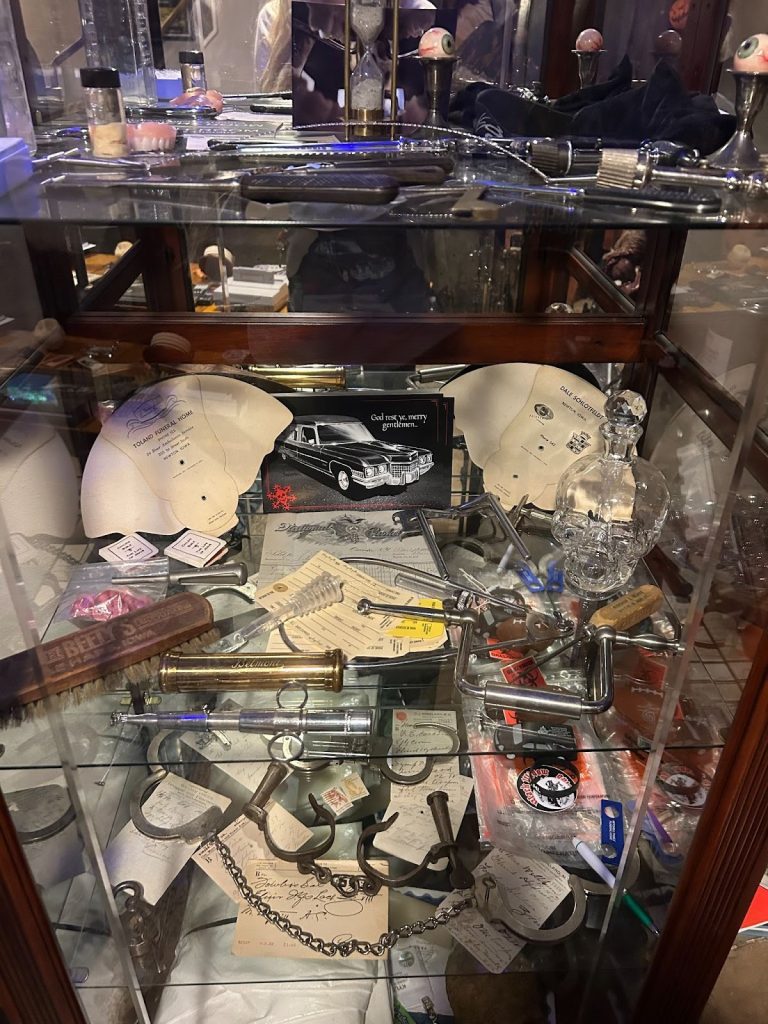
Photo: Rachel Kohl
This process, Rice says, was once performed in the home where the person died, in what Victorians called the “death room.” At the cusp of World War I, funeral homes had already taken the place of these undertakers. Since this was the place families gathered, the “living room” seemed a more appropriate term for the Ladies’ Home Journal, which coined the saying in 1910.
“They don’t embalm bodies in your kitchen anymore. Death’s behind closed doors now,” Rice says. “Nothing is out in the open. Everything’s a secret. It wasn’t a secret back then.”
Six Feet Under
In Rice’s death-themed basement, the only object that feels out of place hangs above the mantel. It’s a collage of photos from the collector’s wedding — a white dress, a black suit, a pretty blonde bride with her bridesmaids, and pink-and-white bouquets to go with them.
When Rice first showed up with the hearse, his wife, Rachel, told him he couldn’t have it around the house. “She said that at first, but she kind of lightened up,” Rice says. “She realized that people actually think it’s cool in a way.”
But his oddities stay confined to the basement. After all, family comes first.
“I wish I could have the whole house, but we might not be married,” Rice says.
On its face, the collection looks like something out of Edgar Allan Poe’s morbid imagination. Maybe it is. But for Rice, it’s about reframing a culture that all too often commercializes death rather than honoring it.
Deathly Generous
In this region, the impending frost isolates us from one another, but in Rice’s eerie world, summer is a death to be celebrated. When Halloween comes around, his cozy ranch expands into a horrifying haunted exhibition that draws in the neighborhood.
“When I was a kid, every house was lit up and everybody in the neighborhood was out,” Rice says. “I want to try to bring that back as much as possible because I thought it was so fun.”
His makeshift haunted house is more than just a collection of 20-foot-tall ghouls and dozens of headstones, though. Visitors can make donations to support childhood cancer treatment at a local Des Moines hospital. This sort of outreach is common at events Rice and his club sponsor.
To an outsider, these connections — celebrating death as a means to avoid it — might seem like morbid irony, but to Rice, they just make a whole lot of sense. When it comes to giving back, the obsession transcends a macabre hobby.
We’re not accustomed to asking for help — but giving it is second nature in the Midwest. Generosity bonds us together as a region, so in the end, it feels right. When a tornado hit his neighborhood, destroying homes and headstones, Rice did what we always do as a region after earth-splintering destruction — he gathered his community. The group collectively raised more than $3,000 to repair the headstone of Victor Muñoz Mejorado, which had been cracked by the storm. Muñoz Mejorado was only 18 when he died.
While Rice’s obsession has answered otherwise unapproachable questions about dying, unnatural death is the only kind he can’t wrap his head around.
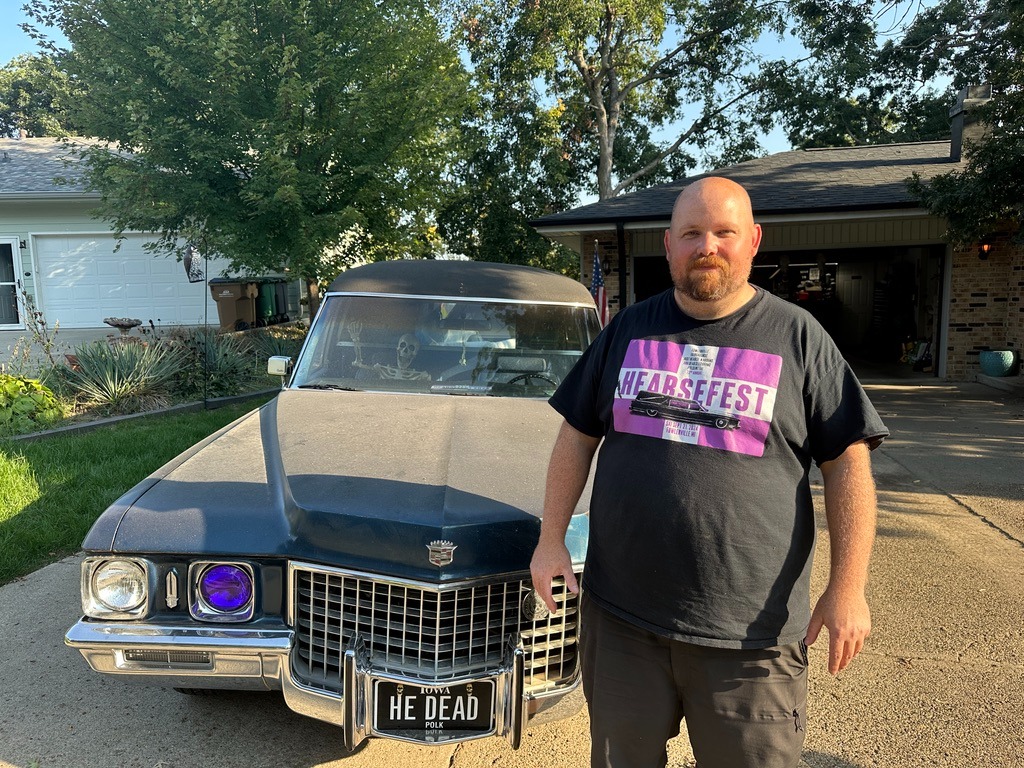
Photo: Emmett McMenamy
“I’m scared shitless,” Rice says. “Lights turn off, and you can’t wake up or think the next day.”
He’s uncomfortable with his own mortality, a little surprising considering death surrounds his life down to his furniture. But that may be just why he — and the rest of us — can’t seem to look away. It’s a brave thing the club does, honoring the dead by poking small holes in the Midwestern stoicism we know all too well.
The founder of the Graveyard Ghouls Hearse Club is not alone in his pursuit of reimagining the concept of death in the Midwest. Amy Putney Koenig, a Des Moines-based artist and death doula, is reshaping grief and trauma with slightly different tools. Click here to read more.
This story is part of a two-piece series:
• Part 1: This Offbeat Midwest Car Culture is Making Peace with Death
• Part 2: There’s No Death Like a Midwest Death
2 responses to “This Offbeat Midwest Car Culture is Making Peace with Death”
[…] I wrote this story for my journalism capstone course — the culmination of my time at the Drake SJMC. Preview below, read the rest of the story here. […]
[…] story is part of a two-piece series:• Part 1: This Offbeat Midwest Car Culture is Making Peace with Death• Part 2: There’s No Death Like a Midwest […]