
Death doulas, morbid art, and reimagining death in the Midwest.
This article includes an optional audio read-aloud for easier accessibility.
There’s a note tacked on the family’s front door with visiting hours listed. The matriarch had a stroke, and things weren’t looking good. Of all moments, this was the time to spend money, they said. Visiting Angels, hospice care — the whole nine yards of end-of-life care — would be brought into the house. Death, according to convention, needed protocol.
Then they heard about Amy Putney Koenig, a death doula.
She sat with the family at a round table in the middle of the chaos. “You don’t need all this,” she said to them. “You can just be here with her.”
The house soon emptied, making way for a quiet death and private grief.
Research shows that most people, around seven in ten, prefer to die at home, surrounded by loved ones, yet most die in a hospital bed, sometimes alone, which can be a dehumanizing end. Sometimes known as death midwives, these doulas function similarly to the traditional sense of the Greek word, a person who supports the birth of human life, though they exist on the other end of the spectrum. Amid the deeply draining process of preparing for death, a doula’s role is to support the spiritual and emotional needs of their clients, the person dying and often their family.
Death, Putney Koenig says, doesn’t need to be a production. Sometimes putting a note on the door with visiting hours is enough.
What’s a Wake?
Matter is neither created nor destroyed, only changed in form. It’s the law of conservation of mass from high school physics class. When a person dies, their body is often swept up by a funeral home and tucked neatly into a casket. Hidden, out of sight, as if it had simply disappeared. But it doesn’t work like that.
Disappearance doesn’t mean dignity. Putney Koenig says she has come to understand this fact.
She’s been a death doula for three years now, helping people bring death back into the fold of our lives. After a person dies, Putney Koenig uses traditional methods such as putting ice around the body and opening windows to preserve it — not for long, usually not more than a day or two — to allow family and friends to spend time with the person before they’re buried or cremated. This is almost like a modern-day version of a wake, a Victorian tradition Midwesterners have long since drifted away from.
“I try to equate it to birth — like a woman who’s having a baby for the first time. ‘I don’t know how to do this,’ but your body knows,” Putney Koenig says. “Your body knows how to have a baby. Our body knows how to die.”
There’s nothing more human than dying, and by virtue, grief is human, too. But in the Midwest, death seems to have become something to “get through” and move past. For generations, it’s haunted our harvests and swirled through the frost belt every November; that we can hunker down and grapple with, but reckoning with the loss of a neighbor or a friend feels like something we should outsource, at a great expense.
While community surrounds us, mourning happens behind closed doors. We look for resolutions from our wicked literary tradition (Ray Bradbury wrote in the book “Something Wicked This Way Comes”: “All death is, however, is a stopped watch, a loss, an end, a darkness. Nothing.”) and the bottom of emptied apple pie tins — solitary spaces — but resist showing vulnerability outwardly. Even as we hold it so close in culture, it’s kept tucked away in a liminal space, covered up by casserole dishes and sincere smiles.
In any community, though, there’s defiance. In this one, maybe it begins as revolutions sometimes do: with an artist at the dead center of it all.
The Spiritual Directors
Putney Koenig doesn’t live by anyone’s rules — not even the rules of death.
While death doulas like Putney Koenig support individuals wherever they wish to die, part of their ethos is advocating for a dignified end of life for all people. There are already signs the culture is shifting — the presence of death doulas in the U.S. has risen more than 500% over the past five years — but, as with most trends, the Midwest takes its time following what’s en vogue.
The modern, sanitized death tradition stems from that mix of capitalism above — the funeral home industry, a commercializing force — but it also feels like something of a collective aversion to acceptance. In assisted-living homes, for example, Putney Koenig says a culture of prolonging life at the expense of dignity and autonomy makes dying feel like something to be ashamed of. “People will feel guilty for not eating. And rather than be supported at the end of life, death is made to feel like a failure.”
Iowa’s version of assisted suicide is to medically help someone starve themselves to death, through what’s called “voluntarily stopping eating and drinking” (VSED). Because medical euthanization is illegal in the Midwest, this is the only legally defensible process available to people with terminal illnesses or advanced age who want to expedite their death. As far as the Iowa Legislature is concerned, right-to-die is a coastal trend, but Putney Koenig thinks they’re dead wrong.
“We need to support and love and hold and carry and make (death) this beautiful thing,” Putney Koenig says. She says long-term care facilities and the funeral home industry have gotten it wrong in trying to put a neat bow on death.
Like Kyle Rice, the hearse collector, Putney Koenig says we “used to be good at death” in the Victorian era when mourning was routine. During that time, most didn’t make it to their fortieth birthday, so dying was more part of the cultural mainstream. Corporatization and modernization may have doubled our life expectancies, but we’ve since let the pendulum slip so far away from acceptance and toward avoidance.
“We limit our living if we won’t acknowledge our dying,” Putney Koenig says. “My thing is, how can we love something so much when it’s alive and then be so repulsed by it when it’s dead? I want to honor that.”
Art: Grief Alchemy
A few lives ago, before she became a death doula, Putney Koenig made art to help her mom grieve the premature death of her sister, Susan (Putney Koenig’s aunt), who died in a car accident at the age of 11. She collaged a collection of artifacts — newspaper clippings, the Girl Scout Brownies dress Susan was wearing at the time of the accident, dried flowers from her funeral — and created an art exhibit. Most of all, she wanted to free Susan from what had become a family legacy of what-ifs and retribution, where there was more focus on who was culpable for Susan’s death (the hospital, the driver) than on healing and honoring Susan’s life. Art is a path toward acceptance, Putney Koenig says, even a powerful tool that can act like alchemy, bringing the right elements together, in one space, creating a new realm of imagination that reshapes reality.
“(Art) is this great alchemical practice of transferring our feelings, emotions, and confusion and laying it out into other types of symbolism in language and healing for ourselves,” she says.
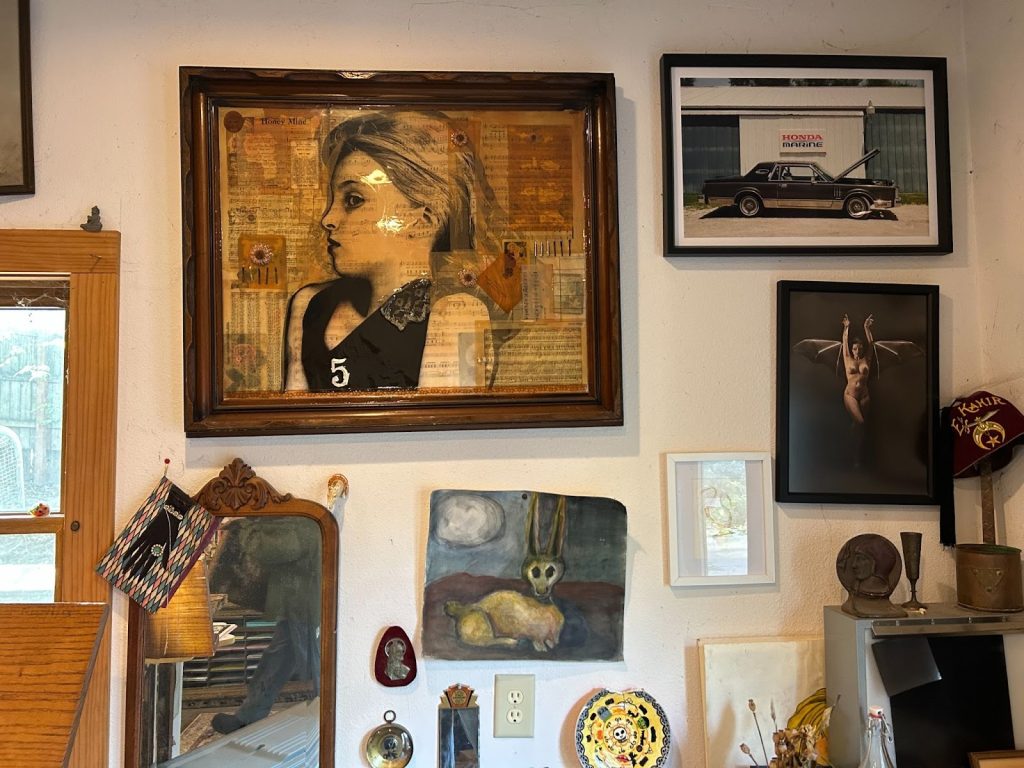
Photo: Rachel Kohl
Putney Koenig spent years digging through family archives, newspaper clippings of her aunt’s death and asking family members about repressed memories. She says she could not look away, that the loss was tragic, but it deserved to be reckoned with. To heal her family, she had to find beauty there.
After years of making this sort of art, though, it felt like something was missing. To Putney Koenig, it felt like she was always making art for other people, but never really for herself.
In 2024, she says she “put it all together” in “Shapeshifter: The Art of Family Tragedy and How to Be Amazing Anyway.” The book is a self-love project, she says, reflecting on generational grief, naming it, accepting it, which helped her find power there. She’s a poet, an artist, and a death doula, all at once.
“It became my job with my artwork, with showing up for myself in a different way, with wanting to be present for my daughter and to be an example of self-love,” Putney Koenig says.
She weaves reflections on death with exercises for the reader — such as a prompt to create a watercolor collage — “If you were to ask a higher power for help, what would it look like?”
Sam Erwin practices Putney Koenig’s craft, too. She’s an art therapist based in Des Moines, Iowa, and she helps her clients express grief, trauma, and every messy emotion that death brings, through art. Compared to talk therapy, Erwin says that art therapy allows a person to breathe. “You’re inviting the person to move,” Erwin says. “You’re inviting the person to even consider changing their mind and throwing that piece of paper away to place another one.”
This form of therapy, processing through artwork, is less prescriptive than it is a “stepping stone” to the eventual goal: acceptance.
Grief is a Communal Ordeal
In the Midwest, we like to tiptoe around sadness; we value stoicism over vulnerability. Erwin says she considers herself a partner, helping a person imagine the gap between the time the person was alive and when they’re dead.
“It’s hard for the mind to wrap that image around what happened between that,” Erwin says. “It gives them comfort to consider that they could alter that image and not really have to give excuses for it.”
Putney Koenig says she doesn’t want people to have to give excuses either. Imagination through art, especially as a collective, helps us process tragedy.
“Everywhere we step is death. There’s death under our feet everywhere. Like the dirt, there’s so much life and death because of the existence on the planet that we’re always within death and around it,” Putney Koenig says.
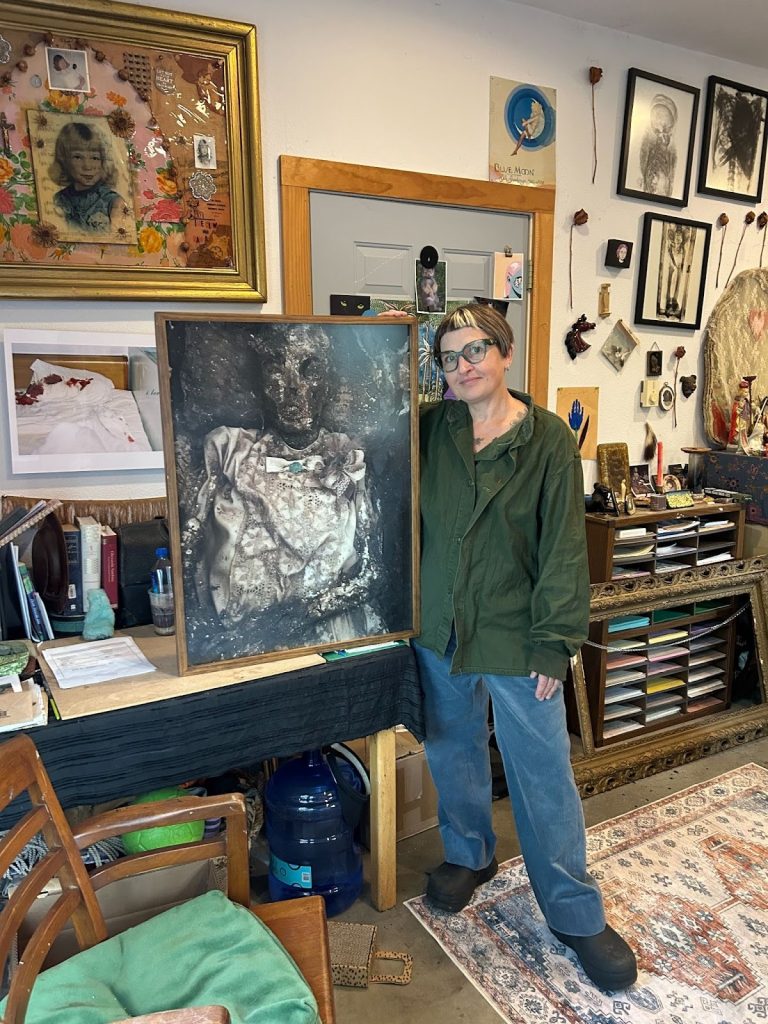
Photo: Rachel Kohl
One warm summer night, before she wrote her book, Putney Koenig invited anyone and everyone in Iowa (and beyond) to step into the small garage that sits between her studio and her home. This was “A Viewing: Art on Death and Reconciliation.”
Attendees brought family artifacts, representing grief that’s been passed down through generations. Putney Koenig took these photos, documents, and clippings, tacking them onto one surface and pouring a clear resin over the top, encasing collective history in one space. Creating this sort of art is healing, she says, an act of archiving. These days, the garage sits mostly empty, except for a dresser so old it’s without sliding tracks; it used to be Putney Koenig’s mother’s. It had been part of the viewing, a symbol of this mother’s grief, and six years later, a reminder that it’s okay to let the past linger a little while.
As much as the people of the Midwest love tradition, we do have a fascination with rebellion, too. Even if that means rejecting our own death culture and reworking something better.
If grief is communal, healing can be, too.
The Midwest has always known how to gather. Maybe we’ve just forgotten how to do it when the end comes for each of us. Think, ‘the Midwest Goodbye,’ but this time, it’s for death.
This story is part of a two-piece series:
• Part 1: This Offbeat Midwest Car Culture is Making Peace with Death
• Part 2: There’s No Death Like a Midwest Death