
Here’s why it’s taken so long, how it’s gone in other central Midwest states, and how it will affect you and me.
This article includes an optional audio read-aloud for easier accessibility
The sportsbook ads are relentless.
Promotions encouraging downloads and sign-up bonuses plague TV and radio stations across Missouri. Highways have been littered with billboards in every direction. The message is clear: Soon, sports betting will be legal in the Show-Me State.
In the last year, one in 10 Americans have placed an online sports bet. On Dec. 1, 2025, Missouri residents will be among them.
Understanding the sports-betting industry is like trying to figure out health insurance — it’s a whole bunch of jargon that only a niche group of people can understand, and one might even get the feeling it’s intentional. When those who seek support for problem gambling describe the process, it sounds a lot like submitting an insurance claim — a cry out into the ether — and they rarely call back.
Urbans Plains has chronicled the legalization of sports betting in Missouri to gather the whole story into one package: First there’s politics, then money follows, and human impact trails behind.
The Timeline
Act I: The Chronicles of MO
Who, What, Where
Missouri will be the 39th state to legalize sports betting — though that specific number is up for debate, depending on if you include Washington, D.C., and Puerto Rico in the tally, or if you count different versions of this type of betting in the nation.
For our purposes in Missouri, the legalization is for online and retail (in-person) sports betting, and despite this unimpressive ranking to legalize, the state has been trying since 2018.
“I would have put Missouri among the early candidates to legalize, along with the first wave of states. They seemed pretty eager at the jump,” said Eric Ramsey, a data and policy analyst for Legal Sports Report.
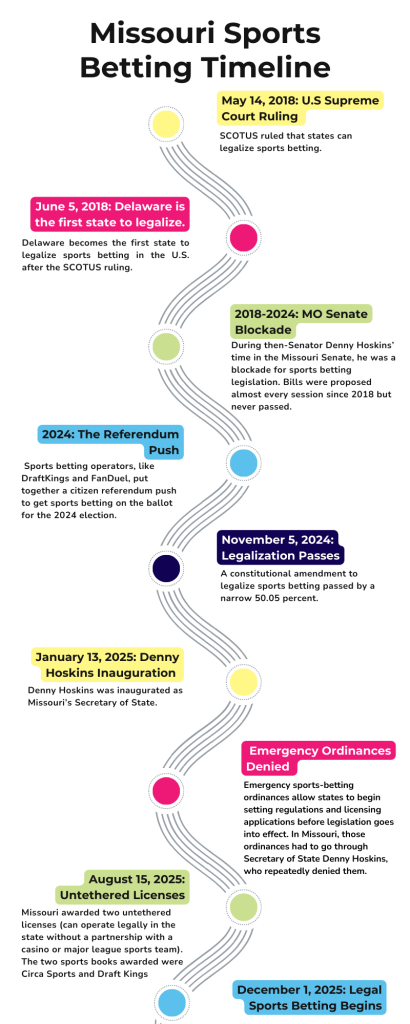
Though several bills have been floated over the past few years, Secretary of State Denny Hoskins has, to some, been a barrier to sports-betting legislation.
According to a statement from Hoskins’ office, “the secretary does not ‘have a problem’ with gaming.”
Steven Bittenbender, a writer and analyst for BetMissouri.com, has met with Hoskins multiple times.
“[Hoskins] says he supports sports betting, and I do believe that,” Bittenbender said. But Hoskins also wants to “see other forms of gambling in Missouri,” namely video lottery terminals. Hence, the almost decade long legislative battle.
But Hoskins’ filibusters in the Senate through multiple sessions caused him to be the person to blame for the sports betting delay in Missouri. “I’m not sure any state has considered more sports-betting bills than Missouri,” Ramsey said. “There was a time when it was like six or eight different bills a year for three or four years. Those just could never get over.”
Rather than wait for Hoskins to be term-limited out of the Senate, where he served before his appointment to secretary of state, sports betting operators, namely DraftKings and FanDuel, put together a citizens’ referendum push to get legalized sports betting on the ballot for the 2024 election.
“[DraftKings and FanDuel] spent millions of dollars getting petitions signed across the state,” Bittenbender said. “They had to go everywhere, because [that’s how the] process works.”
Those citizen petitions turned into a constitutional amendment that was placed on the 2024 election ballot. After a tight election, the amendment passed by a narrow 50.05%.
But Missouri couldn’t rush to get the money flowing as it had to either wait until the referendum start date of Dec. 1, or get an “emergency” ordinance passed to accelerate the process. These types of ordinances can be put in place to allow a state to expedite the regulatory and licensing process — if they’re first approved by the secretary of state.
Missouri tried that route, Bittenbender said, but Hoskins denied the request. Missouri would abide by the referendum-mandated start date of Dec. 1, 2025.
“The rules were not an emergency,” said Hoskins via statement from his office. “Emergency rulemaking is very clearly defined in the statute.”
It’s also worth noting that the Missouri Gaming Commission revised and refiled rules after the amendment passed, making it difficult for any lawmaker to expedite unclear rules.
Making Pairs
The referendum allowed Missouri to award two untethered licenses to sports-betting operators. Untethered licenses allow two operators to act legally in the state without a partnership with a casino or major league sports team — which is the usual route to betting legalization.
Because DraftKings and FanDuel led the movement to get sports betting legalized, Bittenbender said, “we all thought that it was going to be FanDuel and DraftKings that were going to get the two untethered licenses.” In this case, Missouri took the small fry and gave DraftKings and Circa Sports, a lesser-known operator from Nevada, the untethered licenses. The reasoning behind the state’s decision lies in Circa Sports’ unique business model, according to Legal Sports Report, which could attract higher waging bettors — a significant difference from DraftKings and FanDuel.
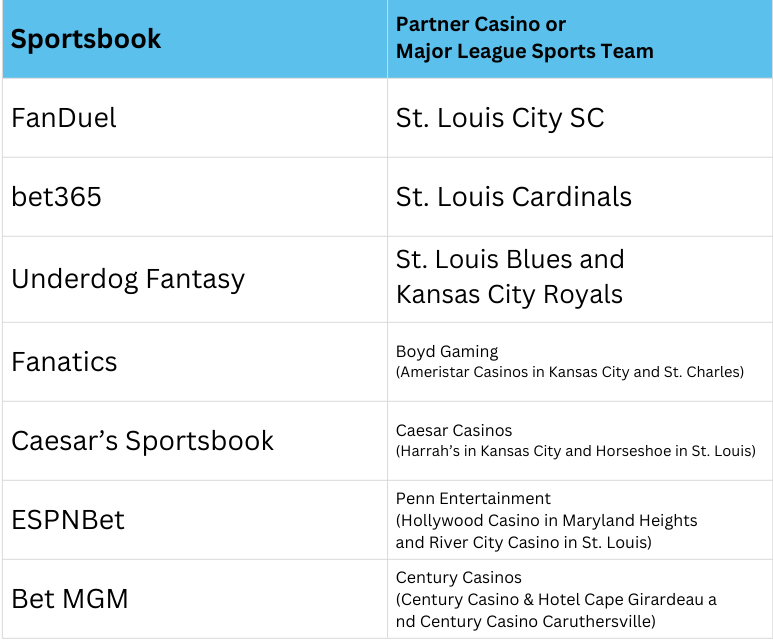
Shortly after the license news, sports books that did not receive the coveted licenses quickly partnered with teams and casinos.
Design: Amanda Favazza
“What the partnership will mean is it’ll provide some revenue for [the casinos],” Bittenbender said. “One thing I’ve learned over the past few years is that the gambling industry is extremely protectionist.”
Sportsbooks are like branches of casinos, and the brick-and-mortar betting industry wants a piece of the pie for helping them legally operate. No matter how much money is bet on the apps, these relationships promote growth for the gambling industry because the house is always winning.
Forcing sportsbook operators to find a pairing ensures that casinos get a piece of the profits, no matter what happens. But, Bittenbender said, it’s “not going to really do anything significantly for the casinos themselves.” Meaning, the money the casinos will receive from their partnered sports books isn’t a high percentage of their revenue.
“[Partnerships] tend to be … more like a symbiotic marketing relationship rather than a financial one,” Ramsey said.
What the pairings really do is cause each member — the operator and the sports club or casino — to promote one another.
Act II: Money
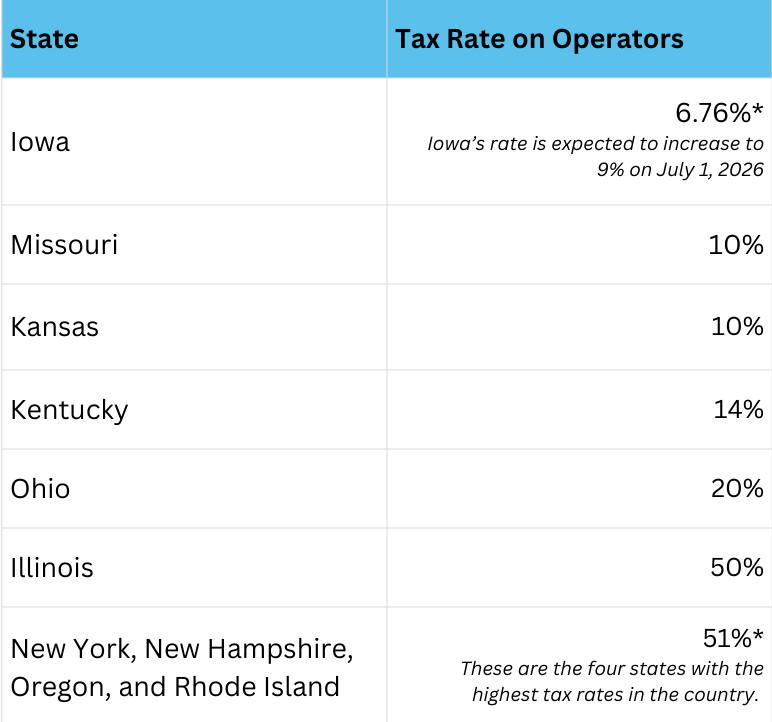
Missouri’s tax rate on operators will be 10%, which is relatively low compared to other states.
Source: https://taxfoundation.org/data/all/state/online-sports-betting-taxes/
Missouri’s rate is a regional average but nationally low.
And that tax gets tricky because operators are allowed to deduct promotional expenses from their tax obligations — so those DraftKings ads that give you a bonus $50 after your first bet don’t have to count that money toward their taxable revenue.
All in all, it’s a very small tax revenue for the state in terms of state budgets. Ramsey notes that physical casinos send around $900 million a year to the state, whereas sports-betting revenue could be around 3% of that. Tax revenue, no matter the amount of zeros, benefits residents through roads, public transportation, police salaries, and parks. It’s not just a word used to help balance a legislative budget — it’s money that goes toward our quality of life. When big revenue generators don’t pay those taxes, residents get the short end of the stick.
“It looks like we’re going to have somewhere around $30 or $40 million in annual tax revenue to Missouri from [sports betting],” Ramsey said. “Which is not insignificant, but … It’s not really going to fill a ton of potholes in Missouri.”
Now, sharing state lines means more than just sharing highways. It means another divide in revenue. While the Midwest has a lot of pride founded in “Midwest nice,” money can divide people faster than a Minnesotan debate over Snickers salad and a St. Louisian’s argument over provel cheese.
Many Missourians have been crossing into Eastern Illinois and Kansas City, Kansas, to wager on sports. As Missourians start to place bets at home, neighbors that have benefited in the past are preparing for a drain of revenue.
Bittenbender said there won’t be much of an impact in Illinois. But with Illinois raising its sports-betting operator tax from 15% to 40% in 2025, he said Illinoisans might actually start crossing the border into Missouri starting Dec. 1.
“Passing along that surcharge to the bettor … does affect odds,” Bittenbender said.
Kansas might see more of an effect once sports betting goes live in Missouri.
“The bigger impact is going to be to Kansas,” Bittenbender said. “Kansas … had a day-long hearing in the legislature a couple of weeks ago to look at what changes they may have to make … to offset any potential loss.”
Both Bittenbender and Ramsey noted that sports betting is a continuously growing market.
“Those markets are still growing natively from their own population, so [change] may not be super noticeable,” Ramsey said. “It may sort of shallow out their growth and start to flatten them out towards the state of maturity, but I don’t think it’s really going to put a big dent in the budget of Illinois and Kansas necessarily.”
Act III: Getting Human
The Schools
Outside the politics and partnerships, the majority of Missouri voters voted for legalization amid an onslaught of campaign messaging claiming that sports betting would support “institutions of elementary, secondary, and higher education” according to campaign ads and the official amendment’s language. But such language was off-putting to some in Missouri education departments.
From a KBIA article in 2024, Bob Dorries, a former American Federation of Teachers Missouri president, voiced his concern with the amendment’s wording.
His argument is that the money collected from casinos will just be shifted through the state’s general operating budget and eventually replace the funds allocated to education. “You’re just playing a shell game,” Dorries said.
Shell game or not, the money isn’t nothing.
According to Des Moines’ primary casino, Prairie Meadows, they have allocated around $900,000 to Polk County schools in 2024. In Illinois, the primary funding for K-12 public schools is through the Illinois Lottery. In 2024, “$884 million was used to fund public education and good causes,” which is about 23 cents of every dollar spent on the lottery. Most of the revenue is given to the Illinois Common School Fund. While that looks like a lot of money, according to the Illinois Association of School Boards, “Lottery money comprised just 1.7% of the state’s commitment to public schools.”
The Gamblers
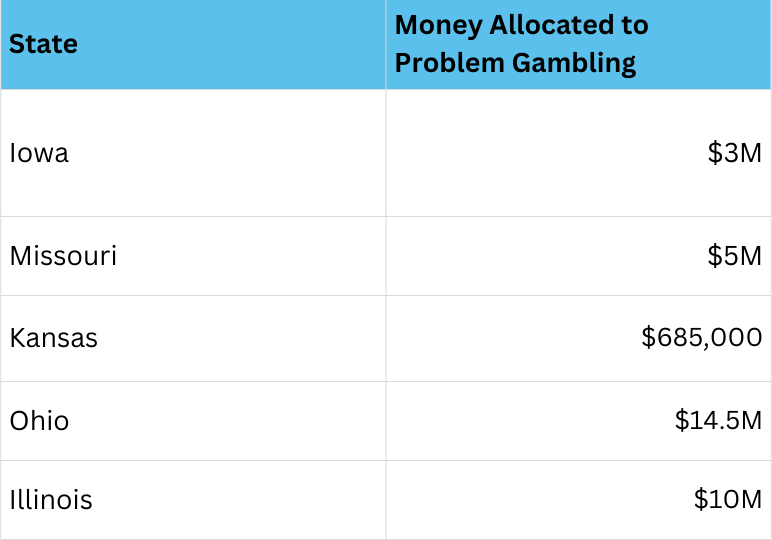
Beneath the moving cups and dice, there’s another location where Missouri tax revenue from sports betting is guaranteed to go: a maximum of $5 million has been allocated to a compulsive-gambling fund.
“Big shout-out to Missouri,” Ramsey said. “One thing they got absolutely right was allocating money to problem-gambling treatment. Five million a year goes directly to resources to help problem gambling … not a lot of states specifically set aside money for that.”
Problem gambling and abuse are real and evident. According to the National Council on Problem Gambling, “the rate of gambling problems among sports bettors is at least twice as high as among gamblers in general.”
But for all gamblers, Dec. 1 may seem like a day out of a dystopian novel. Any sports-betting apps on Missouri residents’ phones will come to life, becoming operational so that Missourians won’t have to drive across state lines to place a bet. They’ll be ready to roll anytime, right from the comfort of their homes.
“When betting becomes easily accessible — especially online — participation increases, and so do related problems,” said Dr. Nona Kocher, a board-certified psychiatrist in New York and Florida. “Not everyone who gambles develops a problem, but when access expands, so does the risk.”
Apps through these operators are easy to access on phones and can send constant push notifications reminding users to enter their parlay.
“Gambling apps use all of the same tools and resources at their disposal as social media apps do,” said Chris Reed, founder of Northern Illinois Recovery Center.
From push notifications, campaigns to share bets on social media, and celebrity advertisements and endorsements, gambling can be as addicting as doom scrolling.
In addition, there’s no science needed to explain that people, particularly in the Midwest, are loyal to a fault to their teams. City pride may push players toward a higher bet rather than looking at the odds.
Urban Plains asked Reed if he thought Missouri will see an increase in problem gambling and the use of addiction resources after Dec. 1.
His answer was immediate and clear: “100%,” he said. “No way it doesn’t.”
Once betting is available through an easy avenue, like an app, and is legal, “Clinics and hotlines often see a noticeable uptick in those reaching out for help,” Kocher said.
And from a nationwide comparison, Missouri’s allocated fund rests in the middle ground.
Source: https://www.menshealth.com/trending-news/a44674774/problem-gambling-resource-allocation-state-guide/
Still, in preparation for more bettors, and possibly more gambling addicts, Missouri’s allocated fund is a step in the right direction.
Money can solve a lot of problems, but there is a severe lack of counselors who specialize in gambling in Missouri. In 2021, one of the last state-funded compulsive gambling treatment programs shut its doors. In 2025, getting help doesn’t look like calling 1-800-BETS-OFF. Now there are programs like KindBridge and Birches Health, which are online therapy companies that specialize in gambling abuse and addiction. Elliott Rapaport, founder and CEO of Birches Health, said that specialized support for gambling has been historically unavailable.
“Even 10 years ago, individuals addicted to gambling, to sports betting, would often either have to drive hours to attend an in-person 12-step meeting or desperately search across fragmented care pathways,” Rapaport said.
Individuals often struggle to find a gambling-specialized therapist, and when they do, they might not be able to afford it.
“If they managed to navigate what was often a web of referrals or hotlines and actually find a therapist, insurance would usually not cover care, and costs would be truly prohibitive,” Rapaport said.
In addition to finding care, treatment plans aren’t universal. Rapaport said that while “12-step programs have saved countless American lives” they may not be the solution for everyone.
It’s a unique approach to supporting gambling addicts in what seems to be a resource desert.
Keeping track of this allocated money, to both education and problem-gambling, should be fairly simple as it’s now part of the state’s constitutional amendment.
“They have to abide by what’s in the constitutional amendment,” Bittenbinder said. “And what will happen is the Gaming Commission will receive that money, and then it will be up to the legislature, in their budgets, to make sure that that money then goes to education [and problem-gambling].”
Missourians, or those near the state’s border, have likely heard a million ads for sports books or even seen the billboards. The media attention seems to aim to reel in bettors, but the amount of media attention is due to its time of passage.
“It’s been a year since we’ve had a [sports betting] launch in another state. So Missouri got a lot of attention,” Ramsey said.
We’ll know if this garnered attention is merited come Dec. 1.