
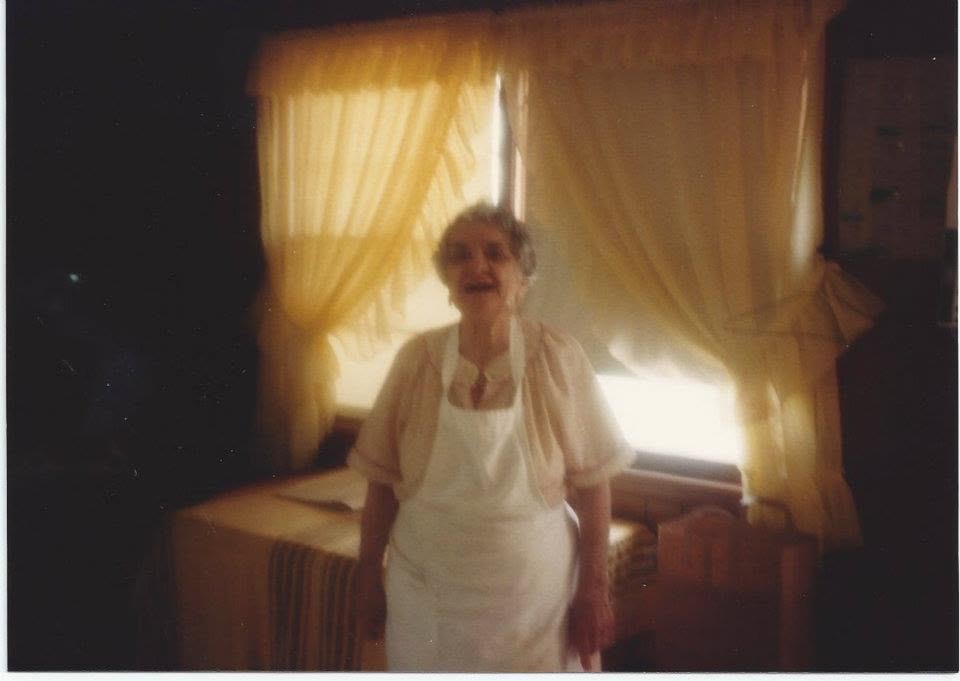
I will always remember the smells of my Papa’s cooking. Walking into my grandparents’ house before Christmas, my mouth watering, with all of the stovetops turned on and running. The salads that left a taste of garlic in your mouth until you woke up the next morning. He had a way of cooking that left people hungry for more, even after they were fed.
When I was about eight years old, St. Boniface Catholic Church in Waukee, Iowa, hosted a fundraiser for the town’s historical society. The lines were so long that people could practically have been waiting in the pews. My Papa was making what he called Alice’s pasta dinner: A compilation of garlic salad, fresh rolls, and, of course, his famous spaghetti. The restaurant he used to run, Alice’s SpaghettiLand, was a Waukee staple for more than 40 years. To this day, he still uses his food as a community builder.
The chatter coming from the church as he put out his first pot of sauce and noodles was when I realized, for one of the first times, that his food had an impact on this community. Although he is convinced that whoever learns the recipe will be cursed forever, that does not change how people yearn for his peppery meat sauce. He is proud in a secretive way. It was one of the first examples I remember of food being used as a tool to impact people and to bring community members together for a singular cause.
Watching my family feed the town with a few big pans helped me understand how impactful this kind of food was. In fact, growing up in the Midwest, food was always used as a way to show community. A casserole for when you move, a casserole for when you have a baby, a casserole for when someone dies.
Nobody called it anything special back then. It was just what you did. When someone’s life shifted, a pan showed up at their door, and no one needed to explain what it meant. The food was saying something unspoken: we’re here, you don’t have to worry about cooking, We’ve got your back. Those pans and dishes were rarely about the recipe. They were about showing up when we needed them most. Papa’s spaghetti dinner in that church hall was the same gesture on a bigger scale, a pot big enough for a whole town.
The food I watched feed the community was, in its own way, the classic Midwest casserole story.
I recently went on KFMG, a local food-focused radio show in Des Moines, Iowa, to talk about casseroles, the quintessential Midwest dinner. A chef, a regional food writer, , and I chatted about the origins, the ones we grew up eating, but most importantly, what a casserole actually means.
But when I asked, bluntly, “So how would you define the casserole?” Chef George Formaro and writer Jim Duncan both laughed. How could a person easily explain this classic dish that means food and community – and everything in between?
“You know, the casserole is originally from whatever scraps farmers had left over, and then what could feed the whole family,” said Duncan
“But you know you could argue that there are types of casseroles all over the world, so it’s tricky to have to find one definition,” followed Formaro.
The word casserole itself comes from the French, where it refers to a saucepan or stewpan. It also has medieval Latin roots in which cattia means “pan” or “ladle.”
Taken literally, most dinners could be considered a casserole in some capacity. But can casseroles be cold? Can they be desserts? Do they have to come from a specific family recipe? The deeper you dive into the idea, the less black and white it becomes.
In Minnesota, most people call it a hotdish and will defend that name with certainty. Other places in the Midwest, it’s just “bringing over a dish.” The labels change, the ingredients change, even the debate is constantly switching up, but the pan keeps showing up anyway.
The only thing we were sure about was what made the casserole distinctly Midwestern–A pan made to bring community together and to be shared amongst everyone.
There are types of casseroles all over the world: the Scots and Brits have Shepards Pie, and the South Africans have Bobotie, for example – but why do people in the Midwest have such an attachment to the idea of the casserole? What makes a casserole distinctly Midwestern isn’t the dish itself. It’s how we use it and the culture that surrounds its preparation.
Most of us have a close, if not familiar, memory of digging into a church basement potluck, or of a family stitching a casserole together from whatever was left in the pantry. I grew up on tuna casserole at home, and on funeral potatoes, green bean casserole, and cheesy potatoes at Thanksgiving.
In the Midwest, the point of a casserole isn’t the casserole. It’s a tool for connection and community: a pan made to be shared.
One response to “My life with the casserole”
Great article! Comforting like a casserole!